
14-05-2026 05:36
Ethan CrensonHi all, I haven't paid much attention to Lachnu
11-05-2026 12:32
 Bernard CLESSE
Pourriez-vous m'aider à identifier cette héloti
13-05-2026 15:26
 François Freléchoux
Bonjour,Voici une récolte faite il y a quelques j
12-05-2026 15:41
 Nicolas VAN VOOREN
Dear Ascolovers, especially interested in Pezizale
13-05-2026 12:05
 Thierry Blondelle
Bonjour à tous,J'aimerais avoir confirmation de c
10-05-2026 23:17
 Andreas Gminder
Hello,today we found in a moist steep decidous for
28-04-2026 20:07
 Lothar Krieglsteiner
... on twig in the air at standing Ceratonia siliq
27-04-2026 20:52
Lothar Krieglsteiner
Found on hanging tiwg of Olea europaea in dried-ou
11-05-2026 20:22
Lothar Krieglsteiner
on attached twig of standing Ficus caricaquite uns
Cudoniella junciseda?
DirkW,
24-05-2020 00:52
 Salut a tous!
Anybody out there, who made experiences with/finds of Cudoniella junciseda?
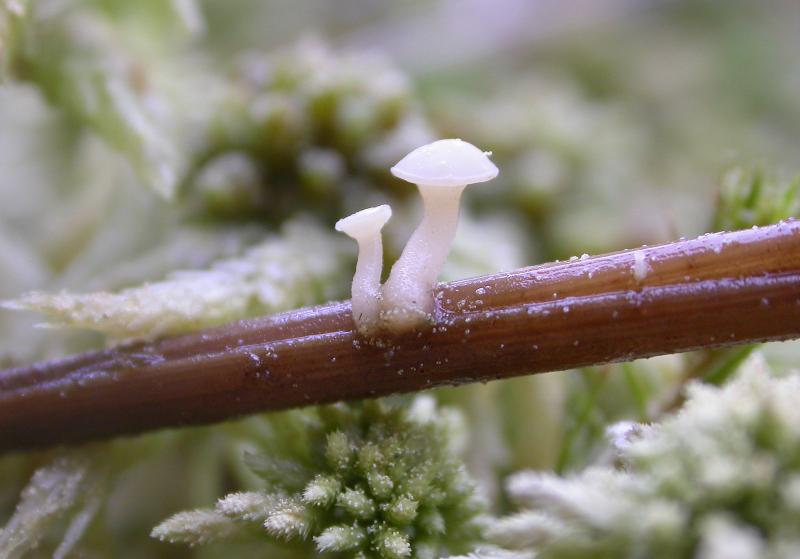
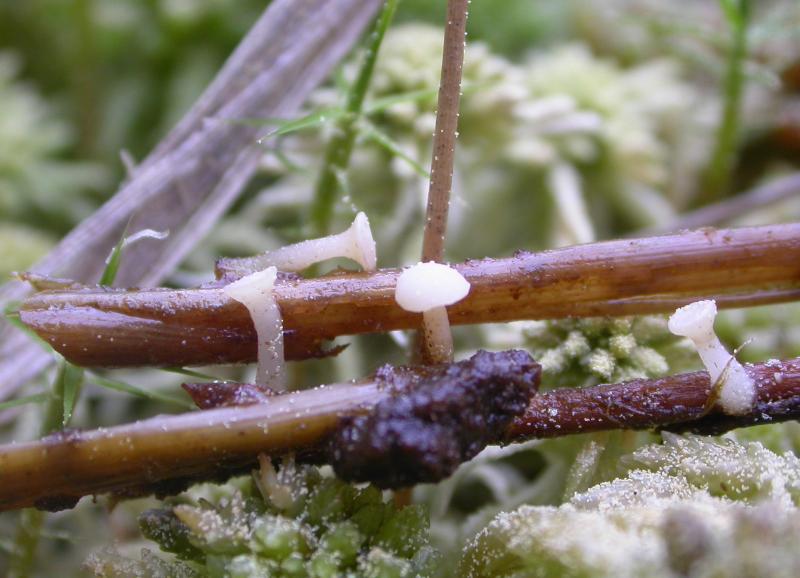
A few days ago we found these little stalked Apothezia on Juncus in a very water-soaked meadow.
Small: 0,3-0,4 cm high, Hymenium 0,2 cm. Base not blackening. Reddening with age.
Spores 11-13 x 4-5, eguttulate, ciboroid, sometimes ovoid, uniseriat. Asci 70-90 x 7, IKI + (very weak, but visible), Croziers. Paraphyses with refractive Guttules. Textura intricata. So, basically this looks like a bonsai-version of cudoniella clavus ;-)
Its quite strange that the Taxon Cudoniella junciseda is shortly mentioned in Dennis and Ellis & Ellis and after this, there is simply nothing. Nothing we know at least. Who knows more?
All best
Dirk
Hans-Otto Baral,
24-05-2020 06:51

Re : Cudoniella junciseda?
Hi Dirk
I think what you have is C. clavus. But the ectal excipulum should be of t. prismatica.
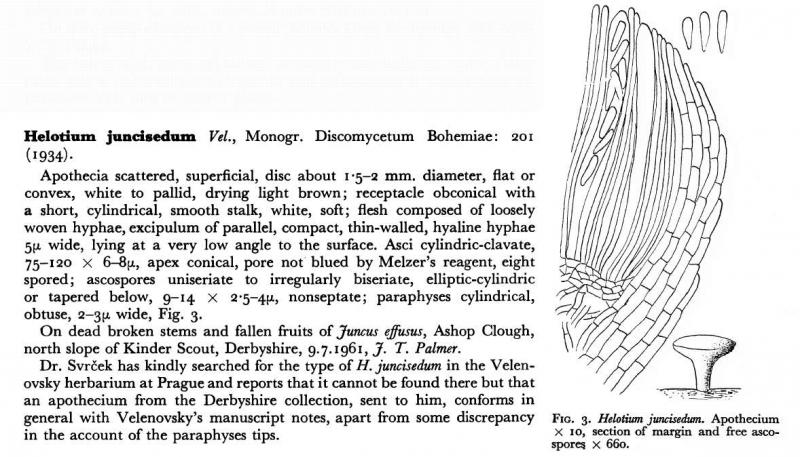
C. junciseda was described by Dennis 1962: 320 from a find by JT Palmer, with narrowly clavate spores of 9-14 x 2.5-4. I do not have a scale to his drawing but it seems to mke that 4 µm is too broad.
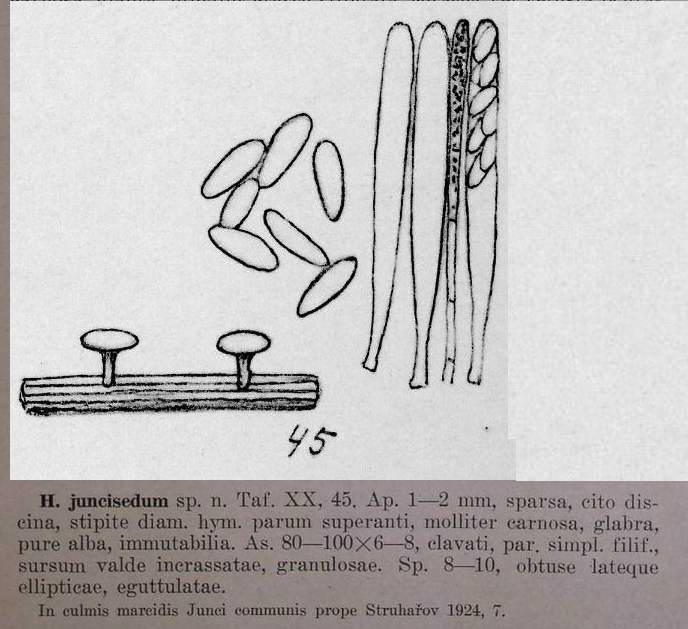
But Velenovsky's short protologue might indeed refer to C. clavus.
Zotto
Viktorie Halasu,
24-05-2020 08:02

Re : Cudoniella junciseda?
Hello,
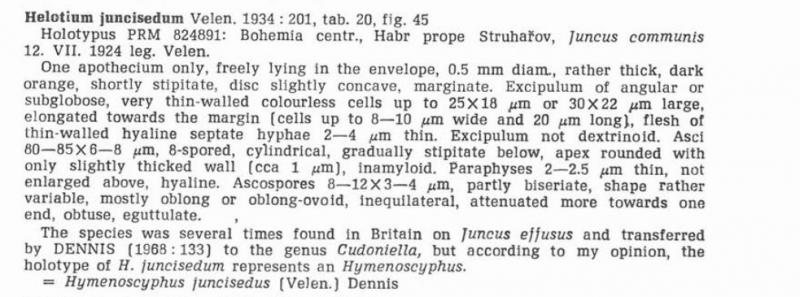
here's Svrcek's revision of the type.
Svrcek (1985) "1984": A taxonomic revision of inoperculate discomycetes described by J. Velenovský in the genus Helotium, preserved in National Museum, Prague. Acta Mus. Nat. Pragae, Ser. B., Hist. Nat. 40(3-4): 129-216.
here's Svrcek's revision of the type.
Svrcek (1985) "1984": A taxonomic revision of inoperculate discomycetes described by J. Velenovský in the genus Helotium, preserved in National Museum, Prague. Acta Mus. Nat. Pragae, Ser. B., Hist. Nat. 40(3-4): 129-216.
Hans-Otto Baral,
24-05-2020 08:10
Re : Cudoniella junciseda?
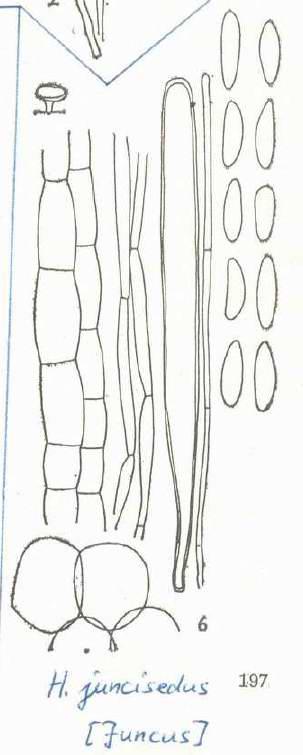
And here his drawing (reference to it missing in the text).
DirkW,
24-05-2020 19:24
Re : Cudoniella junciseda?
dear viktorie and zotto, thank you very much for the fast response and interesting material! very confusing the descriptions and seemingly not reffering to one single taxon! in the Svrcek-revision a textura globulosa-angularis is mentioned! the description and drawning of dennis/palmer says something different.
perhaps zotto is right, and velenovsky was just mislead (as we) by uncharakteristic small apothezia! the variety in c. clavus is really confusing ...
best
dirk
perhaps zotto is right, and velenovsky was just mislead (as we) by uncharakteristic small apothezia! the variety in c. clavus is really confusing ...
best
dirk
DirkW,
25-05-2020 14:10
Re : Cudoniella junciseda?
another point, which is mysterious in case of c. clavus is, that generally a J- is stated in publications! but thats not the case ... its weak, but its there.
Viktorie Halasu,
25-05-2020 15:47
Re : Cudoniella junciseda?
MLZ vs. IKI ?
Hans-Otto Baral,
25-05-2020 20:49
Re : Cudoniella junciseda?
Yes, MLZ could be a reason for a negative report, but also variation may be the reason, which I think I have observed in C. clavus. In another case, Phaeohelotium epiphyllum, I have IKI- and IKI+ collections combined with DNA data which fully concur in the ITS.
So an absent reaction is not necessarily a sign for a separate species.