
10-05-2026 23:17
 Andreas Gminder
Hello,today we found in a moist steep decidous for
14-05-2026 05:36
Ethan CrensonHi all, I haven't paid much attention to Lachnu
16-03-2011 14:31
roman vargas albertoHi. I would like some opinion about this Peziza
11-05-2026 12:32
 Bernard CLESSE
Pourriez-vous m'aider à identifier cette héloti
13-05-2026 15:26
 François Freléchoux
Bonjour,Voici une récolte faite il y a quelques j
12-05-2026 15:41
 Nicolas VAN VOOREN
Dear Ascolovers, especially interested in Pezizale
13-05-2026 12:05
 Thierry Blondelle
Bonjour à tous,J'aimerais avoir confirmation de c
28-04-2026 20:07
 Lothar Krieglsteiner
... on twig in the air at standing Ceratonia siliq
27-04-2026 20:52
Lothar Krieglsteiner
Found on hanging tiwg of Olea europaea in dried-ou
11-05-2026 20:22
Lothar Krieglsteiner
on attached twig of standing Ficus caricaquite uns
Hypoxylon s.l.
Stefan Blaser,
08-11-2019 17:43
Hello everybody,
I'm stuck with this collection and in need of some help.
I found it on a lying Tilia Trunk.
Macro:
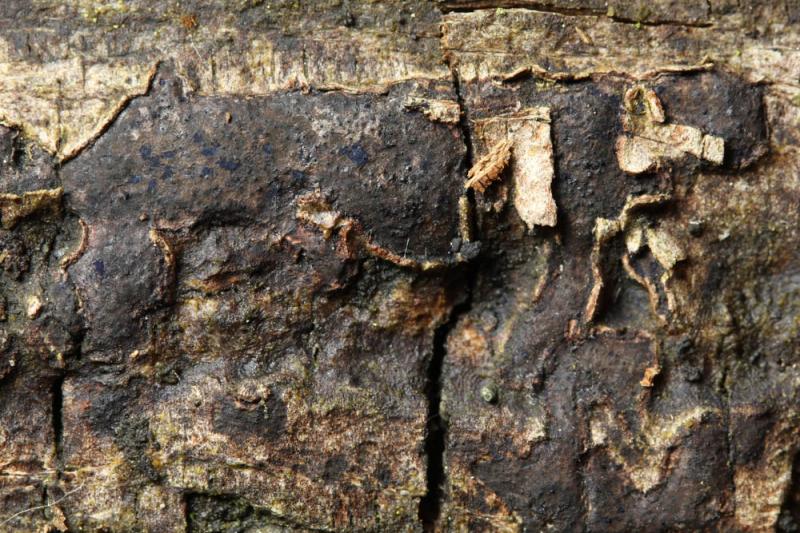
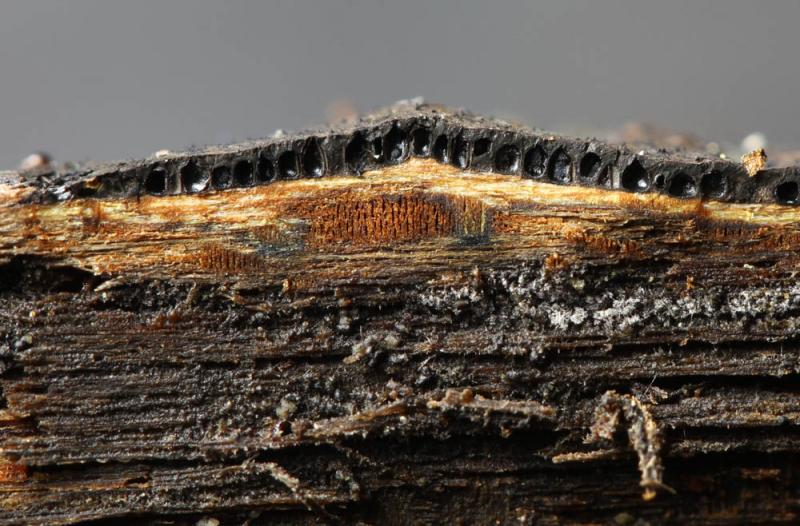
Stromata in patches of variable size and shape from about 0.5-5 cm in Diameter. Very inconspicuous because they are nearly level with the wood surface. Stromatal surface dark brown, smooth, with very inconspicuous perithecial mounds that are level with the stromatal surface. Stroma about 0.6-0.8 mm thick with rather hard (carbonaceous) tissue. Perithecia globose to slightly tubular or pear-shaped, about 0.4-0.5 mm in diameter. Stromatal tissue yields no KOH-Extract.
Stromata in patches of variable size and shape from about 0.5-5 cm in Diameter. Very inconspicuous because they are nearly level with the wood surface. Stromatal surface dark brown, smooth, with very inconspicuous perithecial mounds that are level with the stromatal surface. Stroma about 0.6-0.8 mm thick with rather hard (carbonaceous) tissue. Perithecia globose to slightly tubular or pear-shaped, about 0.4-0.5 mm in diameter. Stromatal tissue yields no KOH-Extract.
Micro:
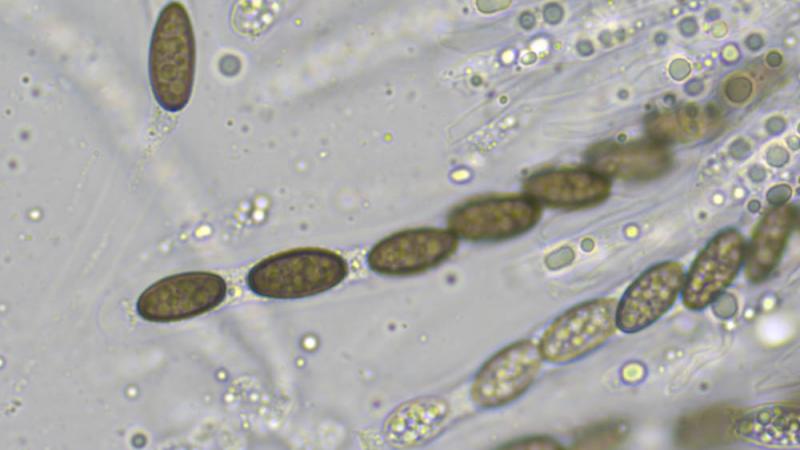
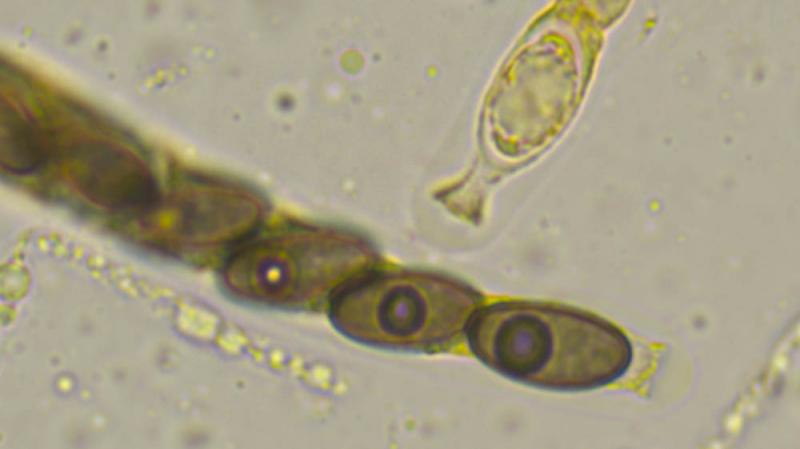
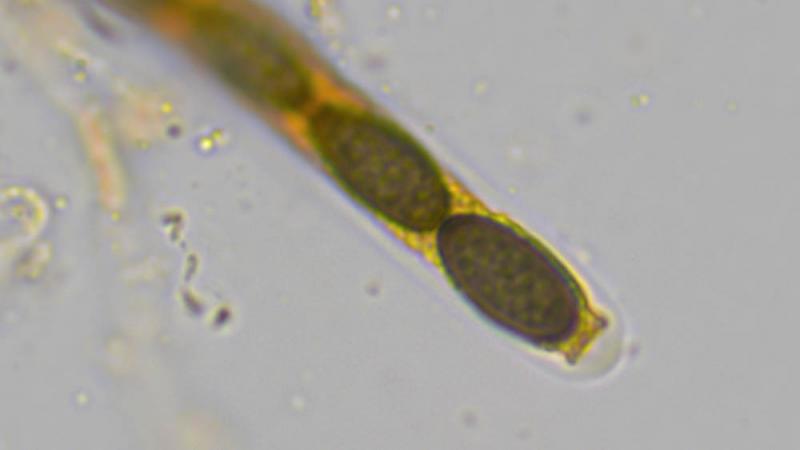
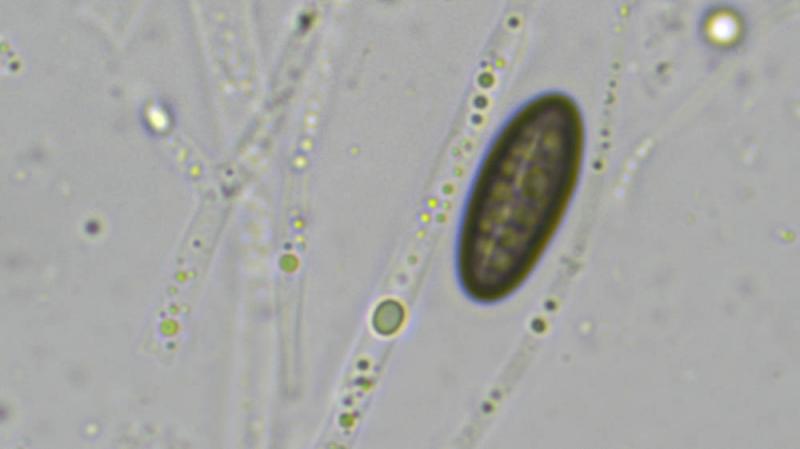
Asci 115-130 x 7-8 µm, with a short stalk, with no reaction in Melzer or IKI. Spores brown, smooth, nearly equilateral to slightly inequilateral, with a straight, spore-length germ slit, 11.5-14.0 x 5.5-6 µm.
Asci 115-130 x 7-8 µm, with a short stalk, with no reaction in Melzer or IKI. Spores brown, smooth, nearly equilateral to slightly inequilateral, with a straight, spore-length germ slit, 11.5-14.0 x 5.5-6 µm.
Thanks for any suggestions,
Best wishes,
Stefan
Jacques Fournier,
08-11-2019 17:58

Re : Hypoxylon s.l.
Hi Stefan,
no longer a Hypoxylon but a Biscogniauxia, B. cinereolilacina, host specific for Tilia.
The stromata are purplish when young and become blackish brown. Your detailed description fits well, including the often inamyloid reaction of the apical apparatus.
Nice find!
Jacques
Stefan Blaser,
08-11-2019 19:42
Re : Hypoxylon s.l.
Hi Jacques, thank you very much. In retrospect I'm wondering why I didn't consider the Genus Biscogniauxia...
I'm very happy about this find as I'm always looking for species of Biscogniauxia, Nemania and Hypoxylon I don't know.
Stefan
I'm very happy about this find as I'm always looking for species of Biscogniauxia, Nemania and Hypoxylon I don't know.
Stefan