
29-05-2026 15:35
daniel FERREBonjour à tous,Je voudrais votre aide pour cette
28-05-2026 16:15
James MitchellHello,Does anyone have the original publication of
28-05-2026 11:06
Thomas Læssøehttps://svampe.databasen.org/observations/10596750
23-05-2026 11:44
 Charles Grapinet
Hello, I am having trouble identifying this copro
25-05-2026 16:44
François BartholomeeusenHi forum members,During an excursion organised by
26-05-2026 21:25
Dirk GerstnerHello everyone, I'm completely stumped by this li
26-05-2026 22:44
Ethan CrensonHi all, I think I have Incrucipulum capitatum her
22-05-2026 14:44
 Lothar Krieglsteiner
in unripe condition citrine yellow, then soon fadi
25-05-2026 16:35
 Bernard CLESSE
Bonjour à toutes et tous,J'ai trouvé récemment,
22-05-2026 13:29
Gernot FriebesHi,I am curious to hear your opinion on this mater
Hymenoscyphus calyculus gr.
Andgelo Mombert,
06-09-2019 21:41

Bonsoir,
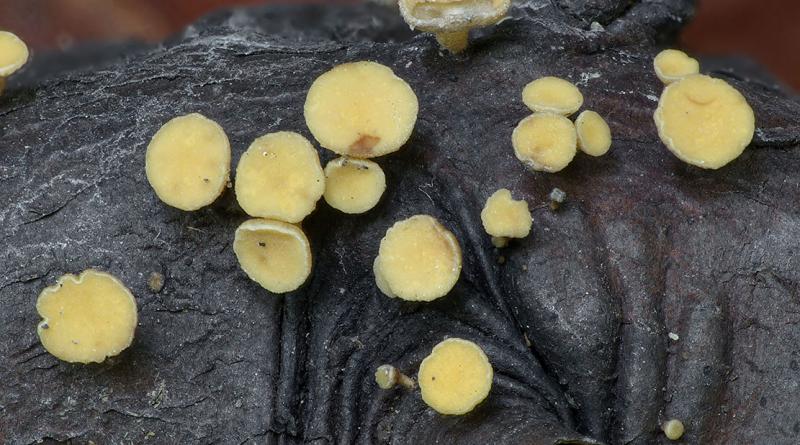
Sur racines de Alnus incana, au bord d'un ruisseau. Isère, vers 1200 m d'alt.
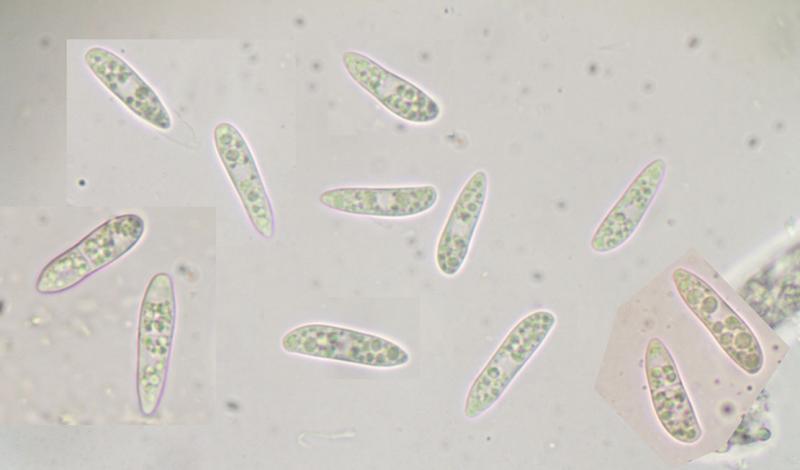
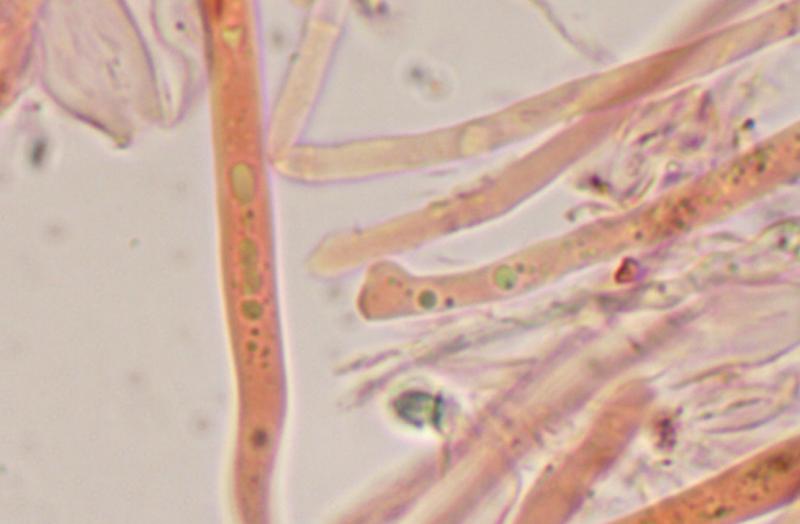
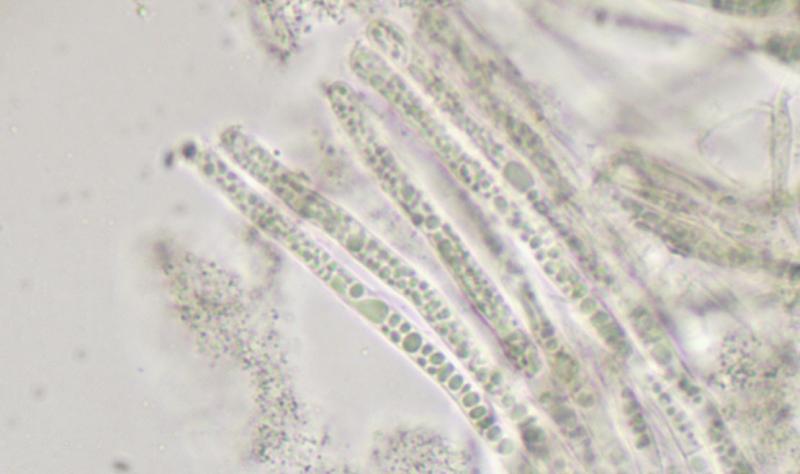
Spores : 14-18,5 x 3,5-4,8 µm, scutuloïdes, avec une extrémité aigue et l'autre un peu recourbées, garnies de guttules sauf au niveau du centre, hyalines, lisses, avec une cloison à maturité.
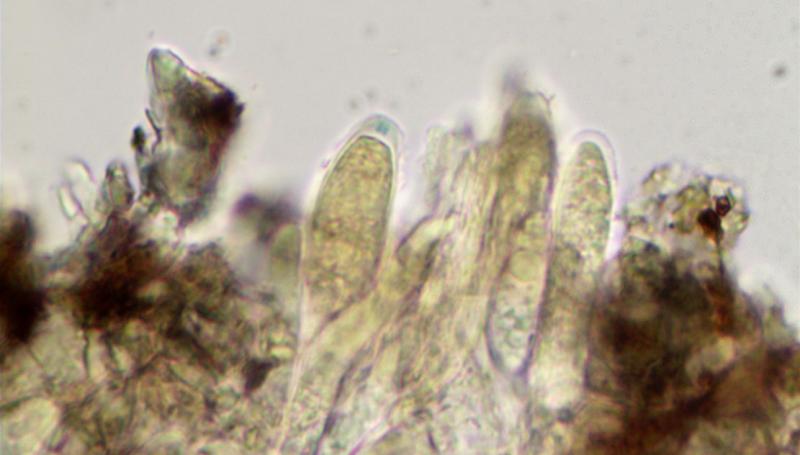
Asques : 115-130 x 9-10 µm, cylindriques, à sommet amyloïde, avec crochet, contenant huit spores.
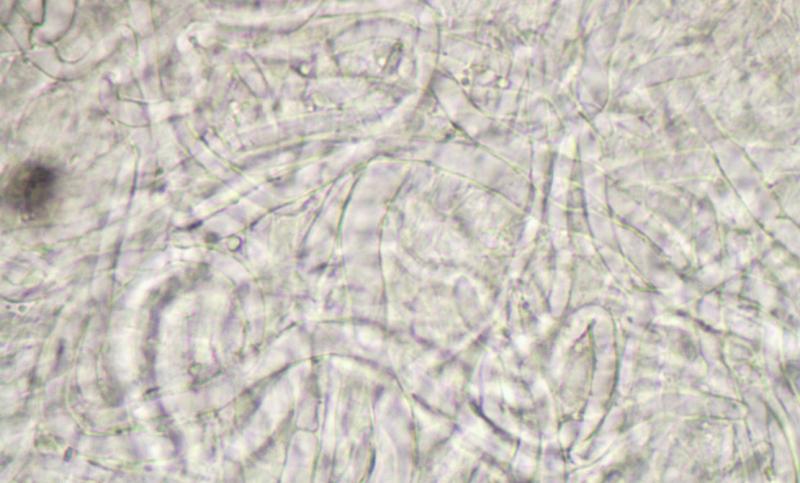
Paraphyses : grêles, cylindriques, non renflées au sommet, larges de 2,5-3,2 µm, garnies de guttules réfringentes, hyalines.
On arrive à distinguer les extrémités des spores, je pense qu'il s'agit de calyculus et non de subferrugineus... Merci d'avance pour votre aide.
Andgelo
Hans-Otto Baral,
06-09-2019 21:52

Re : Hymenoscyphus calyculus gr.
Hmm, I am not sure why this is not subferrugineus. But I must admitI have problems with what is H. calyculus. I fear to be sure we need a sequence. H. subferrugineus is very clearly defined by its DNA. For calyculus different clades exist and eveyrthing is unclear.
The spore septum indicates overmaturity, mature spores are non-septate in most Hymenoscyphi.
I downloaded your photos and would be glad to add collection data.
Zotto
The spore septum indicates overmaturity, mature spores are non-septate in most Hymenoscyphi.
I downloaded your photos and would be glad to add collection data.
Zotto
Andgelo Mombert,
06-09-2019 22:04
Re : Hymenoscyphus calyculus gr.
Merci.
J'ai lu que la caractéristique de subferrugineus est que l'on ne peut pas distinguer l'extrémité de l'autre de la spore... Donc ce n'est pas toujours le cas ?
On en reste à subferrugineus ? Si tu veux, je peux t'envoyer un exsiccata.
J'ai oublié d'indiquer que les apothécies rougissent dans les blessures.
Voici les coordonnées : 30/08/2019, Mizöen, lieu-dit le moulin de Mizoën, 1175 m. Coordonées GPS : 45,058593 ; 6,148314
Hans-Otto Baral,
06-09-2019 22:24
Re : Hymenoscyphus calyculus gr.
No, subferrugineus has scutuloid spores not very prominent, but easy to see the base. Where did you read about it?
Andgelo Mombert,
06-09-2019 22:31
Re : Hymenoscyphus calyculus gr.
Hans-Otto Baral,
06-09-2019 22:36
Re : Hymenoscyphus calyculus gr.
Indeed, i said that in laetus and epiphyllus it is impossible.
Bernard Declercq,
19-09-2019 16:07

Re : Hymenoscyphus calyculus gr.
Hi Andgelo and Zotto,
This is indeed not an easy one.
Both H. subferrugineus and H. calyculus have mostly only slightly scutuloid spores (this scutuloid aspect may be mostly lost in dead spores as I could observe in the type collection of H. calyculus) with overlapping size.
For the moment being, I separate both species as follows:
H. caudatus: asci less than 150 µm long; spores filled with large and small guttules;
H. subferrugineus: asci > 150 µm long; spores filled with small guttules ( up to 1,5 µm diam.).
However, several collections have overlapping characteristics, e.g. the swiss collection HB3128E has calyculus-like spores combined with very long asci.
Bernard
Hans-Otto Baral,
19-09-2019 17:54
Re : Hymenoscyphus calyculus gr.
Hi Bernard
what do you mean with "type of calyculus"? I am not sure if Fries kept material, did he?
And you think H. calyculus (or caudatus?) has shorter asci than subferrugineus? 150 µm in living or dead state?
what do you mean with "type of calyculus"? I am not sure if Fries kept material, did he?
And you think H. calyculus (or caudatus?) has shorter asci than subferrugineus? 150 µm in living or dead state?