
11-05-2026 12:32
 Bernard CLESSE
Pourriez-vous m'aider à identifier cette héloti
13-05-2026 15:26
 François Freléchoux
Bonjour,Voici une récolte faite il y a quelques j
12-05-2026 15:41
 Nicolas VAN VOOREN
Dear Ascolovers, especially interested in Pezizale
13-05-2026 12:05
 Thierry Blondelle
Bonjour à tous,J'aimerais avoir confirmation de c
10-05-2026 23:17
 Andreas Gminder
Hello,today we found in a moist steep decidous for
28-04-2026 20:07
 Lothar Krieglsteiner
... on twig in the air at standing Ceratonia siliq
27-04-2026 20:52
Lothar Krieglsteiner
Found on hanging tiwg of Olea europaea in dried-ou
11-05-2026 20:22
Lothar Krieglsteiner
on attached twig of standing Ficus caricaquite uns
29-04-2026 10:44
Lothar Krieglsteiner
growing at moist, drying-out soil at the side of a
Black Asco Embedded in Decorticated Salix Wood
Peter Thompson,
29-06-2019 14:56
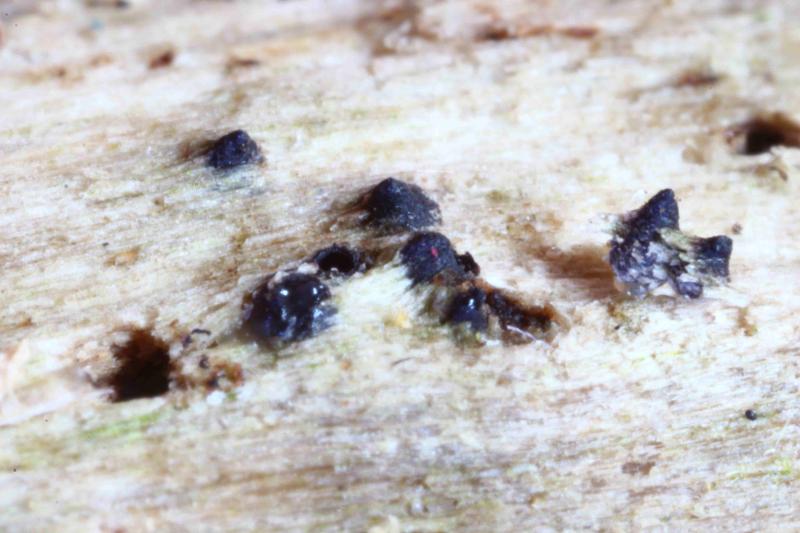
I have found an ascomycete which is partially immersed in wet, decorticated Salix wood, in an alder and willow carr environment. The black perithecia have conical ostioles and spheres containing spores and asci. They are gregarious, but individual fruit bodies, rather than being embedded in a stroma.
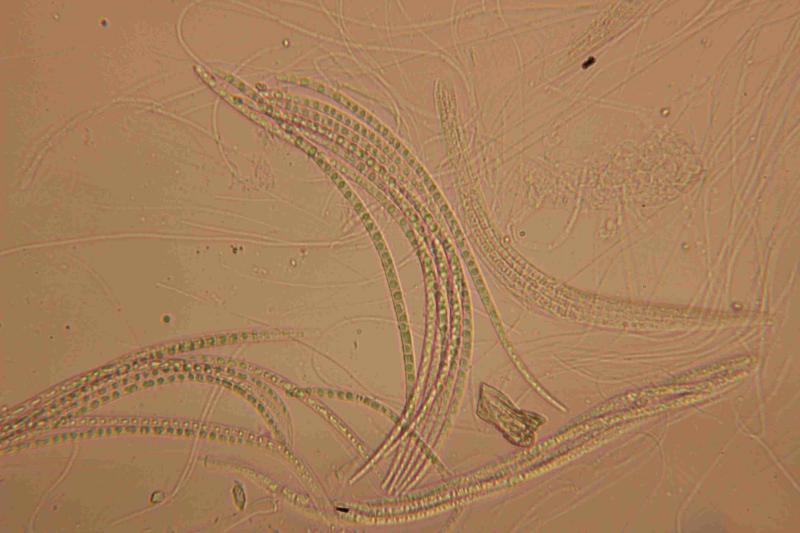
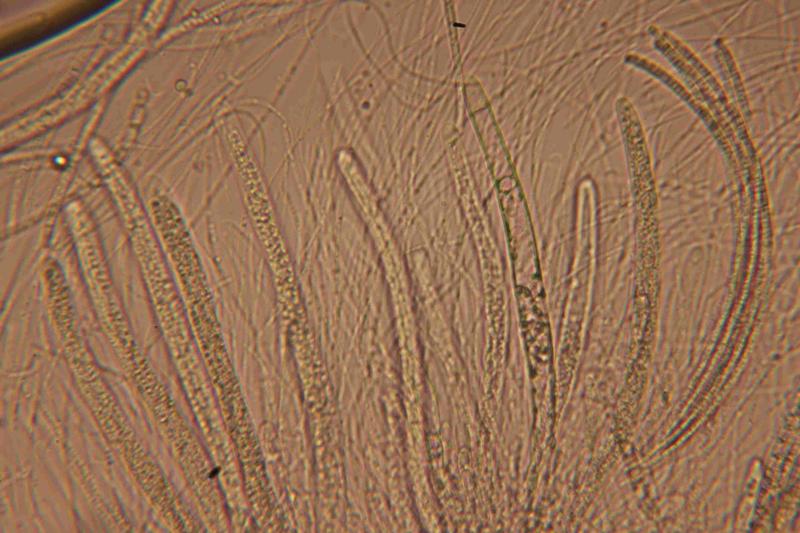
The spores are needle shaped, hyaline, about 32-septate, with one guttule per cell, typically 135 to 150 x 3 um. There are no distinctly swollen cells in the spores. The long, slender asci do not react to lugol. The paraphyses are filiform and plentiful.
I have attached a photo of the fruit bodies - the pair on the right have been extracted from the host. Also, micro photos of the loose spores and asci plus paraphyses.
I wonder if anyone has an idea as to what they might be?
Thank You,
With Best Wishes,
Peter.
Jacques Fournier,
29-06-2019 15:24

Re : Black Asco Embedded in Decorticated Salix Wood
Hello Peter,
if this pyreno is "big", i.e. 0.5-1 mm high, it might be Daruvedia bacillata.
Jacques
lowen roz,
29-06-2019 15:26
Re : Black Asco Embedded in Decorticated Salix Wood
Greetings, Peter,
Is your asco from New Zealand? It looks like from the Clavicepitaceae but I cannot see the ascus apex well enough. Can you send an enlarged image?take care
Roz
Is your asco from New Zealand? It looks like from the Clavicepitaceae but I cannot see the ascus apex well enough. Can you send an enlarged image?take care
Roz
Peter Thompson,
29-06-2019 16:33
Re : Black Asco Embedded in Decorticated Salix Wood
Hello Jacques and Roz,
Thank you for your replies.
Jacques - The perithecia are 0.75 mm high, so within the range which you quoted. I have not heard of the genus Daruvedia, nor the species bacillata. Is there any reference material to access, to read about the genus and its species?
I notice that the species has been assigned to Ophiobolus and Ceratostomella in the past. Ophiobolus did come to mind, because of the spore structure, but always hosted by herbaceous plants.
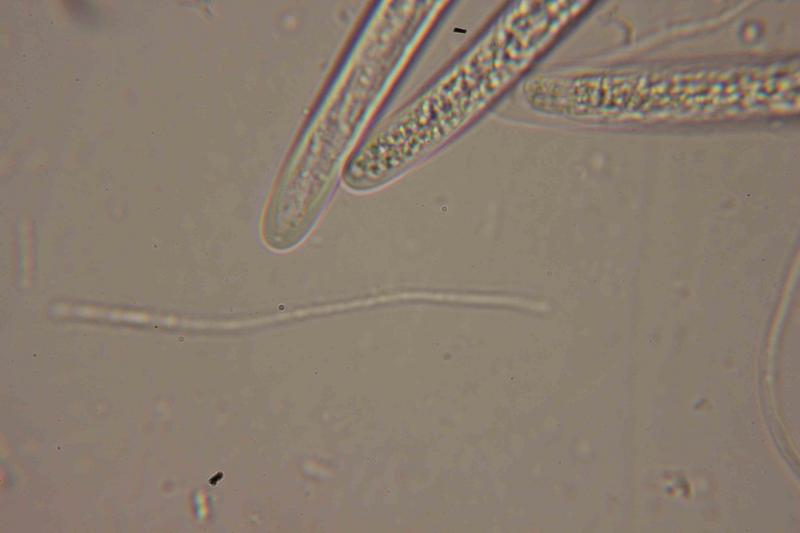
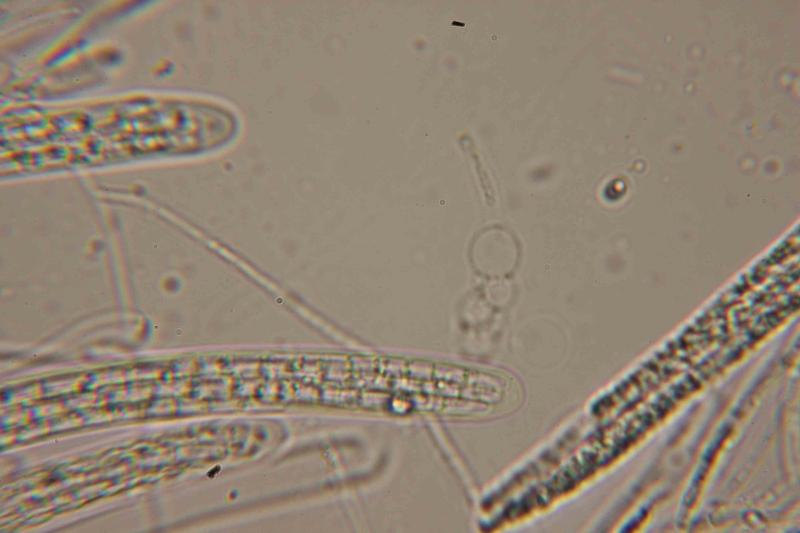
Roz - The sample was collected in central England. I have attached photos, taken under 100x with immersion oil, of young and mature asci. There seems to be a thickened, almost refractive tip visible at least when the ascus is young.
Thank You,
With Best Wishes,
Peter.
Thank you for your replies.
Jacques - The perithecia are 0.75 mm high, so within the range which you quoted. I have not heard of the genus Daruvedia, nor the species bacillata. Is there any reference material to access, to read about the genus and its species?
I notice that the species has been assigned to Ophiobolus and Ceratostomella in the past. Ophiobolus did come to mind, because of the spore structure, but always hosted by herbaceous plants.
Roz - The sample was collected in central England. I have attached photos, taken under 100x with immersion oil, of young and mature asci. There seems to be a thickened, almost refractive tip visible at least when the ascus is young.
Thank You,
With Best Wishes,
Peter.
lowen roz,
29-06-2019 16:57
Re : Black Asco Embedded in Decorticated Salix Wood
So it is not in the Clavicepitaceae. It was the wrong type of host anyway.index fungorum indicates that the Genus Daruvedia is lichenized in the pyrenulaceae.
Sorry I cannot help.
regards
Roz
Sorry I cannot help.
regards
Roz
Jacques Fournier,
29-06-2019 17:13
Re : Black Asco Embedded in Decorticated Salix Wood
Peter,
I just sent you privately a paper published in Mycotaxon in 2010, that unfortunately does not resolve the phylogenetic placement of this fungus. However you can check the morphology of your sample.
Best,
Jacques
Peter Thompson,
30-06-2019 09:45
Re : Black Asco Embedded in Decorticated Salix Wood
Hello Jacques and Roz,
Thank you both for your contributions about my sample.
I have had a look at the Mycotaxon 2010 document, and there is no doubt that my sample is the same as the description and illustrations of Daruvedia bacillata.
There are some British records in the national fungus database (CATE2), but none as far north as my find in Shropshire.
With Best Wishes,
Peter.
Thank you both for your contributions about my sample.
I have had a look at the Mycotaxon 2010 document, and there is no doubt that my sample is the same as the description and illustrations of Daruvedia bacillata.
There are some British records in the national fungus database (CATE2), but none as far north as my find in Shropshire.
With Best Wishes,
Peter.