
05-05-2026 22:40
Gernot FriebesHi,I believe this is a Plagiostoma growing on a Sa
04-05-2026 18:13
 Stephen Martin Mifsud
ID request for what seems to be a true aquatic fun
04-05-2026 16:39
Stephen Martin Mifsud
ID request: This specimen was collected in Malta o
28-07-2011 18:31
 Alex Akulov
Dear FriendsToday I made the pdf file of Velenovsk
28-04-2026 20:07
 Lothar Krieglsteiner
... on twig in the air at standing Ceratonia siliq
04-05-2026 09:50
 Castillo Joseba
Me mandan el material seco de Galicia,(España) re
02-05-2026 12:42
Alain BRISSARDBonjour à tousJeuidi 30 avril dernier on m'a remi
02-05-2026 13:06
Pauline. PennaBonjour Please can someone help me with this id
01-05-2026 22:45
 Thierry Blondelle
Bonjour à tous, Une récolte sur bouse séchée d
White ascolichen (?) on burnt ground
Enrique Rubio,
18-03-2019 12:06
 Hi to everybody
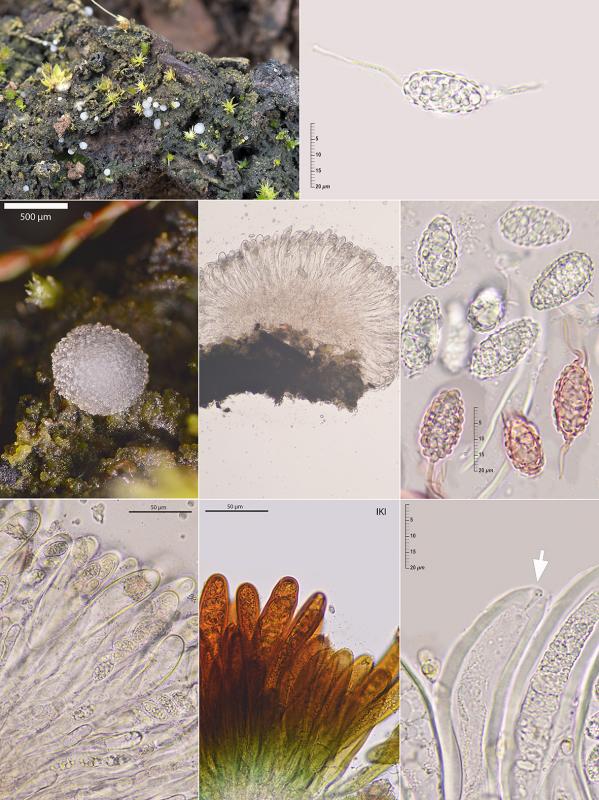
These minute, white, sessile, pruinose, hemisphaerical, neither applanate nor cupulate, 0.5-0.7 mm in diameter, grew among Ceratodon purpureus and algae on sandy burnt soil.
The thick-walled, strongly dextrinoid asci which may appear to be bitunicate, have an irregular apical dehiscence as in some Mniaeceia species (white arrow). No conspicuous paraphyses I have seen. Ascospores coarsely verrucose.
Some idea for it?
Many thanks again
Enrique
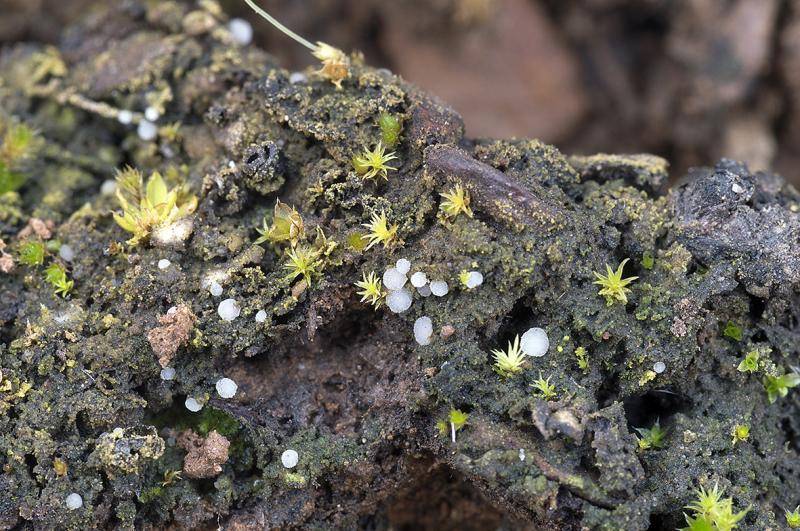
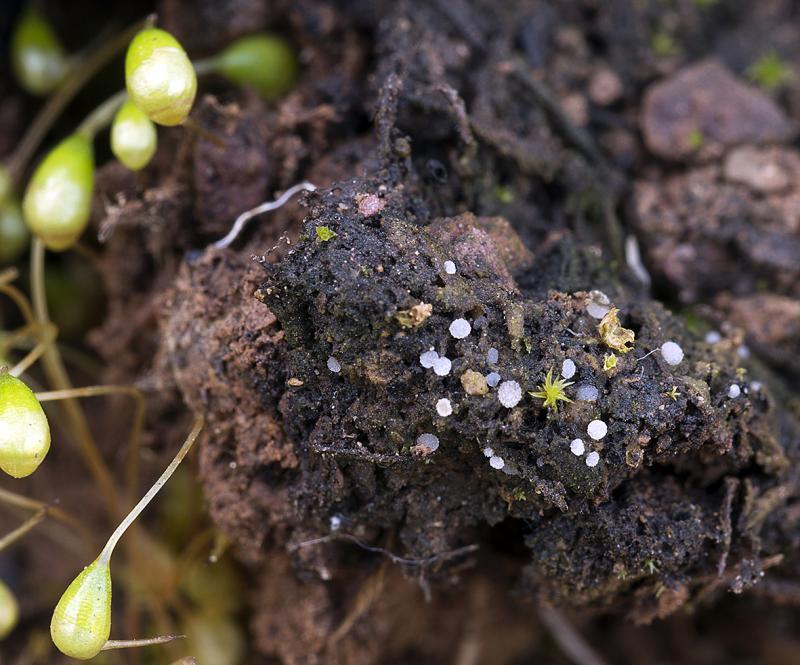
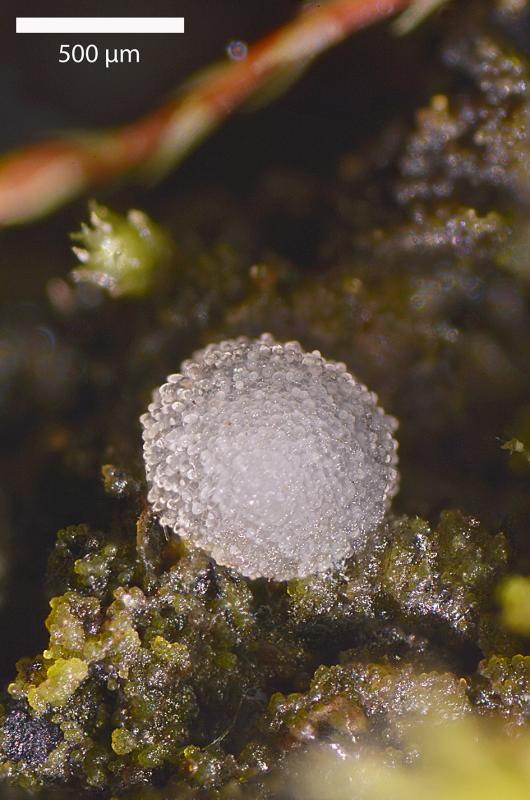
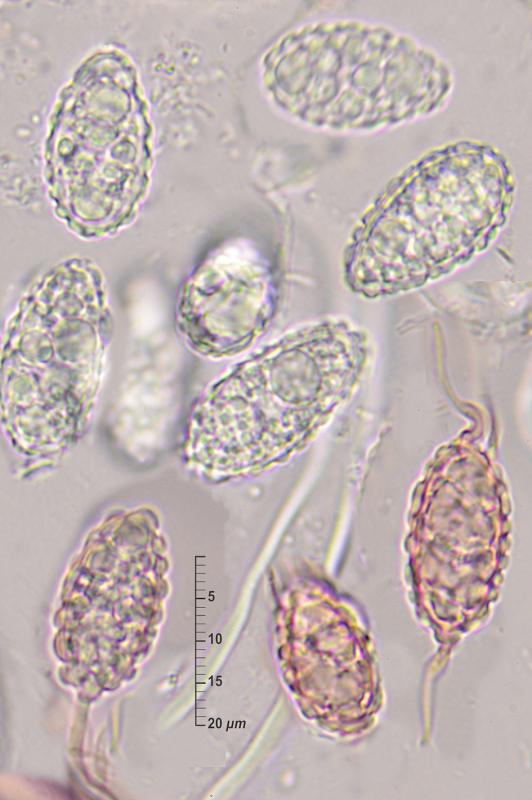
Hans-Otto Baral,
18-03-2019 12:16

Re : White ascolichen (?) on burnt ground
Hi Enrique
superb. The asci are hemiamyloid, not dextrinoid, and I am quite sure this belongs in Vezdaea. No idea about a name, I have no key at hand.
Zotto
superb. The asci are hemiamyloid, not dextrinoid, and I am quite sure this belongs in Vezdaea. No idea about a name, I have no key at hand.
Zotto
Enrique Rubio,
18-03-2019 12:21
Re : White ascolichen (?) on burnt ground
Hi Zotto
Could you explain to me the differences between hemiamyloid and dextrinoid?
Could you explain to me the differences between hemiamyloid and dextrinoid?
Hans-Otto Baral,
18-03-2019 12:27
Re : White ascolichen (?) on burnt ground
This is quite easy:
dextrinoid is a red reaction that is seen in both Lugol and Melzer (better in the latter), and if you pretreat with KOH it is still red.
hemiamyloid is only red in Lugol, and if you KOH-pretreat, the reaction is blue.
In your Vezdaea surely the asci will react blue after KOH.
Besides, I never met an ascus with an outer wall reacting dextrinoid.
Zotto
dextrinoid is a red reaction that is seen in both Lugol and Melzer (better in the latter), and if you pretreat with KOH it is still red.
hemiamyloid is only red in Lugol, and if you KOH-pretreat, the reaction is blue.
In your Vezdaea surely the asci will react blue after KOH.
Besides, I never met an ascus with an outer wall reacting dextrinoid.
Zotto
Enrique Rubio,
18-03-2019 12:43
Re : White ascolichen (?) on burnt ground
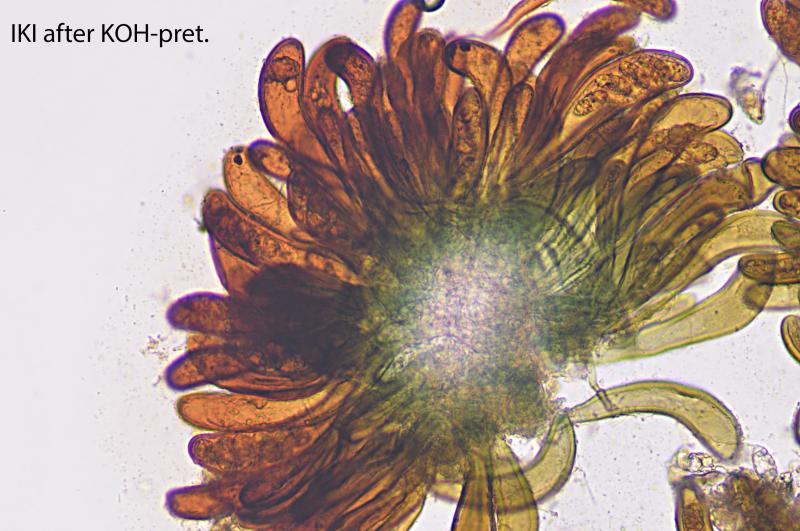
Really I don't see much changes after KOH-pret. Just like it used to be, the basal part is bluer and the apical one is redder.
Hans-Otto Baral,
18-03-2019 12:50
Re : White ascolichen (?) on burnt ground
Did you also test MLZ for whether the red appears?
Enrique Rubio,
18-03-2019 13:08
Re : White ascolichen (?) on burnt ground
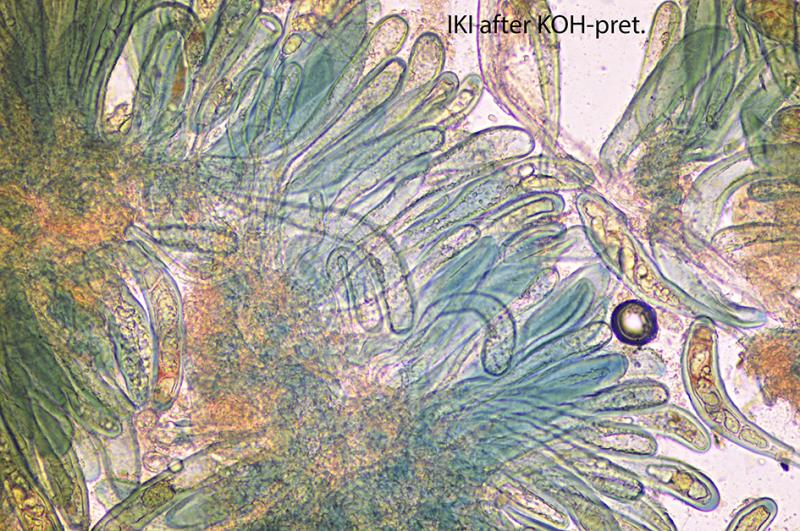
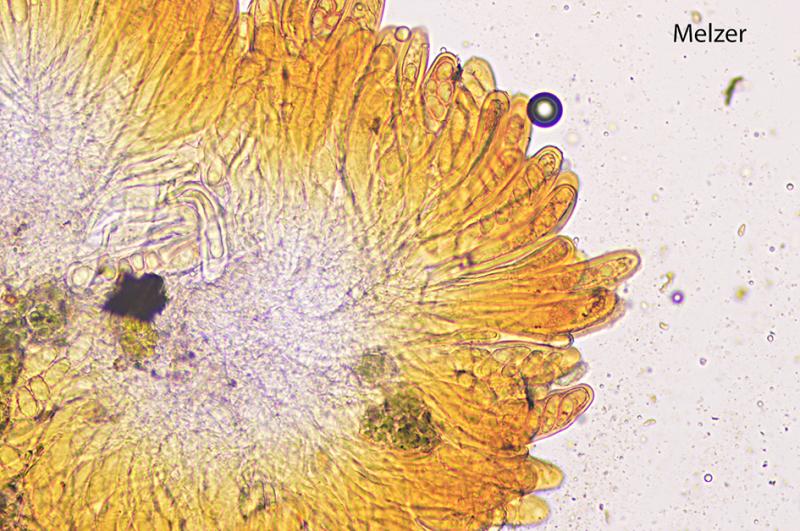
Only orange, without any bluish hue, in Melzer's reagent. Blue and reddish colors are present in IKI after KOH-pret. There are bluish and reddish asci.
Antonio Gómez-Bolea,
18-03-2019 14:48
Re : White ascolichen (?) on burnt ground
Yes is Vezdaea
V. rheocarpa fits well with your sample.
Hans-Otto Baral,
18-03-2019 15:25
Re : White ascolichen (?) on burnt ground
I suppose your first KOH-pretreatment was not strong enough. In the second I see only blue ascus walls. Higher KOH-concentrations or a short heating over a flame assure that the chemical conversion takes place.
MLZ without KOH should be negative, I think the orange is due to plasma staining by the colour of iodine.
MLZ without KOH should be negative, I think the orange is due to plasma staining by the colour of iodine.
Enrique Rubio,
18-03-2019 15:48
Re : White ascolichen (?) on burnt ground
Thanks, Zotto and Antonio.
I will look for V. rheocarpa.
I will look for V. rheocarpa.
Enrique Rubio,
18-03-2019 16:12
Re : White ascolichen (?) on burnt ground
By the way
Has someone the invalid description of Vezdaea rheocarpa Poelt & Döbbeler, Bot. Jb. 96(1-4): 347 (1975)?
Many thanks in advance
enrirubio@asturnatura.com
Has someone the invalid description of Vezdaea rheocarpa Poelt & Döbbeler, Bot. Jb. 96(1-4): 347 (1975)?
Many thanks in advance
enrirubio@asturnatura.com