
12-06-2026 14:50
 François Freléchoux
Bonjour, Voici la brève description d'une Mollis
10-06-2026 21:16
François Freléchoux
Bonsoir,Le dernier du jour, en attendant votre avi
11-06-2026 19:01
 William Slosse
Hello all,In an attempt to make a culture of a sus
11-06-2026 19:03
 Nicolas VAN VOOREN
Chers membres d'Ascofrance,Le site sera placé en

09-06-2026 18:32
Camille MertensSur morceau de roseau immergé 0,5 - 0,7 mm de dia
10-06-2026 12:54
Steve ClementsBonjour encore, Pouvez-vous m'aider, s'il vous pl
10-06-2026 21:07
François Freléchoux
Toutes les tiges de gentianes jaunes de l'an passÃ
10-06-2026 13:41
François Freléchoux
Bonjour à nouveau, Voici une trouvaille d'hier.
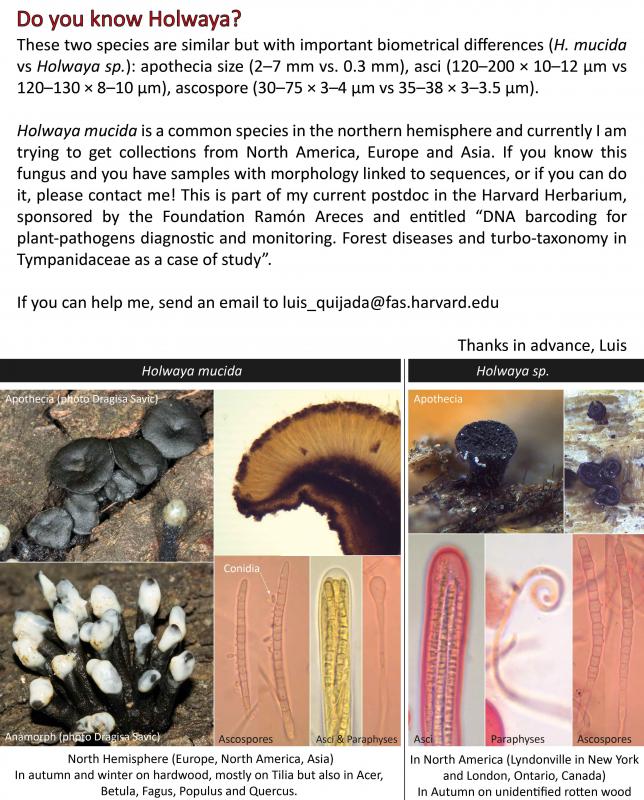
Searching Holwaya samples with morphological details and sequences
Quijada Luis,
13-09-2018 20:25
Hans-Otto Baral,
13-09-2018 21:32

Re : Searching Holwaya samples with morphological details and sequences
Hi Luis
are you sure with the spore measurements? Your Holwaya sp. has spores which look like having about the same l:w ratio as H. mucida, i.e. maybe 50 x 3.5 µm but not only 10x longer than wide.
Also the fungus looks larger than 0.3 mm to me, but here I may be wrong.
You figured a curled paraphysis, which seems a strong further difference between the two?
Did you try the wood anatomy? Is it an angiosperm?
Zotto
are you sure with the spore measurements? Your Holwaya sp. has spores which look like having about the same l:w ratio as H. mucida, i.e. maybe 50 x 3.5 µm but not only 10x longer than wide.
Also the fungus looks larger than 0.3 mm to me, but here I may be wrong.
You figured a curled paraphysis, which seems a strong further difference between the two?
Did you try the wood anatomy? Is it an angiosperm?
Zotto
Quijada Luis,
14-09-2018 15:48
Re : Searching Holwaya samples with morphological details and sequences
Hi Zotto,
the measures included they were taken from manuscripts. Each photo was enlarged or shortened only to show the morphology, not for comparison in the figure. Holwaya sp. is around 0.3 mm, the samples that I reviewed the size of the apothecia were around 200-300 um.
As you said, the main morphological difference is the paraphyses.
I cannot identify the wood of the samples under Holwaya sp. because I reviewed them years ago and I do not have the samples, but maybe I can ask to the herbarium if they can help me with that.
I am trying to find help to compare that samples from the northern hemisphere of H. mucida, I think this is something that would be interesting.
Best
Luis
the measures included they were taken from manuscripts. Each photo was enlarged or shortened only to show the morphology, not for comparison in the figure. Holwaya sp. is around 0.3 mm, the samples that I reviewed the size of the apothecia were around 200-300 um.
As you said, the main morphological difference is the paraphyses.
I cannot identify the wood of the samples under Holwaya sp. because I reviewed them years ago and I do not have the samples, but maybe I can ask to the herbarium if they can help me with that.
I am trying to find help to compare that samples from the northern hemisphere of H. mucida, I think this is something that would be interesting.
Best
Luis
Hans-Otto Baral,
14-09-2018 16:17
Re : Searching Holwaya samples with morphological details and sequences
Would be be helpful to clarify if it was an angiosperm or gymnosperm.
I meant the length:width ratio seems incorrect: when you measure the left spore of Holwaya sp. and take it as 38 µm long, then it has a width of maybe 2.5-2.7 µm, so I thought it could be longer than 38 µm to fit your width values.
I meant the length:width ratio seems incorrect: when you measure the left spore of Holwaya sp. and take it as 38 µm long, then it has a width of maybe 2.5-2.7 µm, so I thought it could be longer than 38 µm to fit your width values.
Blasco Rafael,
03-03-2025 13:32

Re : Searching Holwaya samples with morphological details and sequences
Hola. He recogido el estado imperfecto de Holwaya mucida, como se tiene que nombrar, Crinula caliciformis o Holwaya mucida.
Veo las dos referencias para el estado imperfecto, pero cual es el correcto ??
Un saludo
Rafael
Veo las dos referencias para el estado imperfecto, pero cual es el correcto ??
Un saludo
Rafael