
06-05-2026 11:25
 Castillo Joseba
Me mandan el material seco de Galicia (España) re
28-04-2026 20:07
 Lothar Krieglsteiner
... on twig in the air at standing Ceratonia siliq
05-05-2026 22:40
Gernot FriebesHi,I believe this is a Plagiostoma growing on a Sa
04-05-2026 18:13
 Stephen Martin Mifsud
ID request for what seems to be a true aquatic fun
04-05-2026 16:39
Stephen Martin Mifsud
ID request: This specimen was collected in Malta o
28-07-2011 18:31
 Alex Akulov
Dear FriendsToday I made the pdf file of Velenovsk
04-05-2026 09:50
Castillo Joseba
Me mandan el material seco de Galicia,(España) re
02-05-2026 12:42
Alain BRISSARDBonjour à tousJeuidi 30 avril dernier on m'a remi
02-05-2026 13:06
Pauline. PennaBonjour Please can someone help me with this id
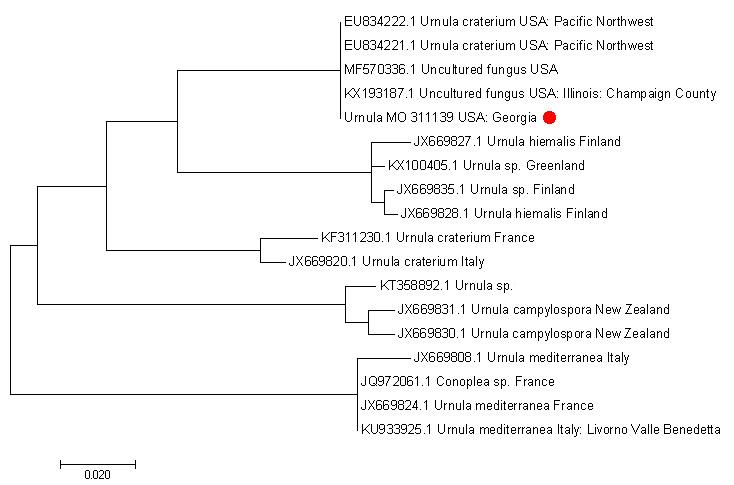
 While I was in Georgia, USA last month on Bill Sheehan's property I collected what we call Urnula craterium in North America. I sequenced the ITS1 + ITS2 + some of the LSU, and found that all of the close NCBI BLAST matches are from North America, and the European sequences are quite a bit different. Since it's a name from Europe, and the North American taxa fall into a separate clade, it's probably undescribed.
The collection I sequenced is http://mushroomobserver.org/311139, marked with a red dot in the tree.
If anyone wants to work on describing this I am happy to mail my collection. It's just a few fruit bodies and I wouldn't use it as a holotype, but it'd be a good studied collection.

The macroscopy seems to me quite different from European Urnula spp.
You don't have the facility to take microphotos? Important would be to photograph the living spores in water(they surely stay alive some months or even years in the herbarium) to see the oil drop pattern, which is different among species of Urnula.
Zotto
Hi Alan,
I'm working on the Urnula craterium complex for 3 years (or little more). I have ready the paper to be submitted to Ascomycete.org. :D
I have sequenced many collections from all over the Europe and also some from USA.
Your collection seems to be a good Urnula craterium to me.
The name is not a European name, in fact Scwheinitz described it from North Carolina! ;)
Anyway, if you want we can keep on discussing on your samples and see what happens if we put your sequences in my (unpublished) phylogenetic tree! ok? :D
All the best
Matte