
11-05-2026 12:32
 Bernard CLESSE
Pourriez-vous m'aider à identifier cette héloti
13-05-2026 15:26
 François Freléchoux
Bonjour,Voici une récolte faite il y a quelques j
12-05-2026 15:41
 Nicolas VAN VOOREN
Dear Ascolovers, especially interested in Pezizale
13-05-2026 12:05
 Thierry Blondelle
Bonjour à tous,J'aimerais avoir confirmation de c
10-05-2026 23:17
 Andreas Gminder
Hello,today we found in a moist steep decidous for
28-04-2026 20:07
 Lothar Krieglsteiner
... on twig in the air at standing Ceratonia siliq
27-04-2026 20:52
Lothar Krieglsteiner
Found on hanging tiwg of Olea europaea in dried-ou
11-05-2026 20:22
Lothar Krieglsteiner
on attached twig of standing Ficus caricaquite uns
29-04-2026 10:44
Lothar Krieglsteiner
growing at moist, drying-out soil at the side of a
Discomycète sur écorce
Pascal RIBOLLET,
05-09-2017 09:31
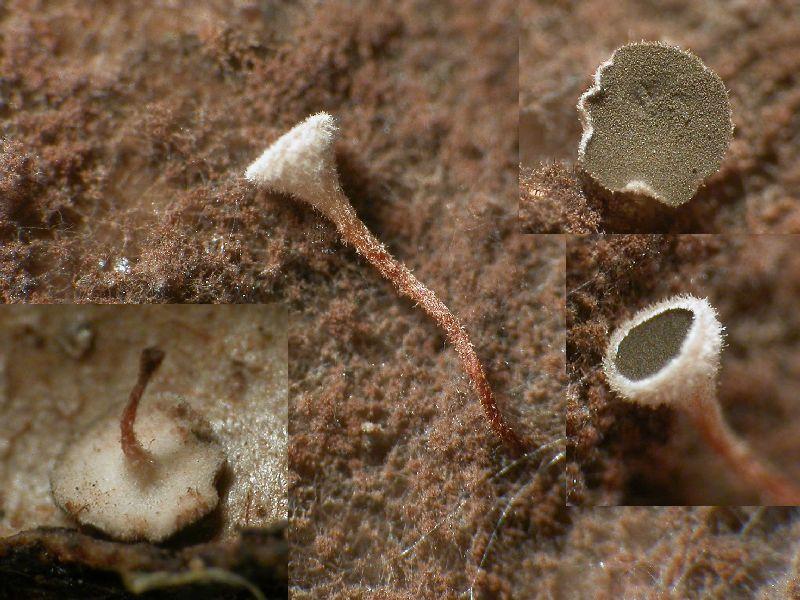
Trouvé sur écorce de feuillu, il émergeait d'un Tomentella sp (mais pas greffé dessus).
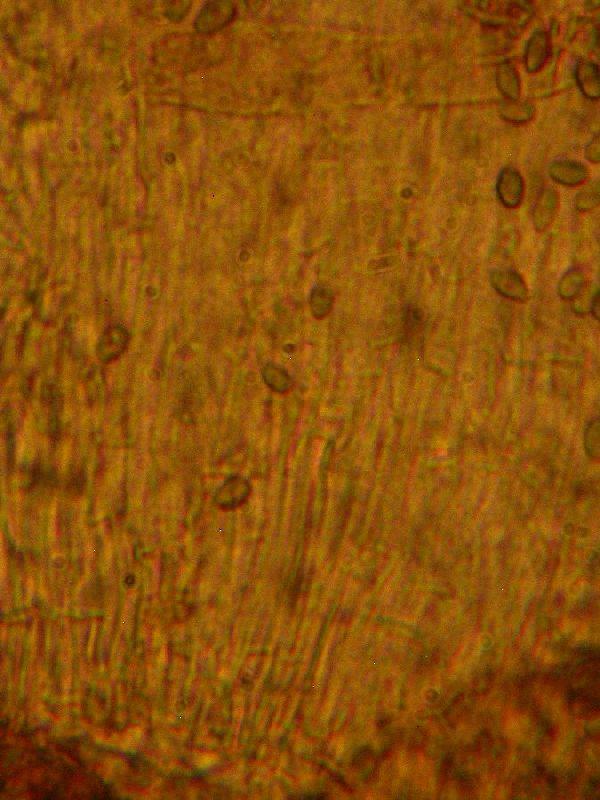
Coupe jusqu'à 1 mm de diamètre, longuement stipitée (jusqu'à 3mm). Spores brunes déjà dans l'asque, 3,5-4,5 (5) x 2-2,5 µm, lisses (immersion), deux guttules discrètes. Asques 35 x 5 µm, à 8 spores unisériées, MLZ-
Pas observé de paraphyses.
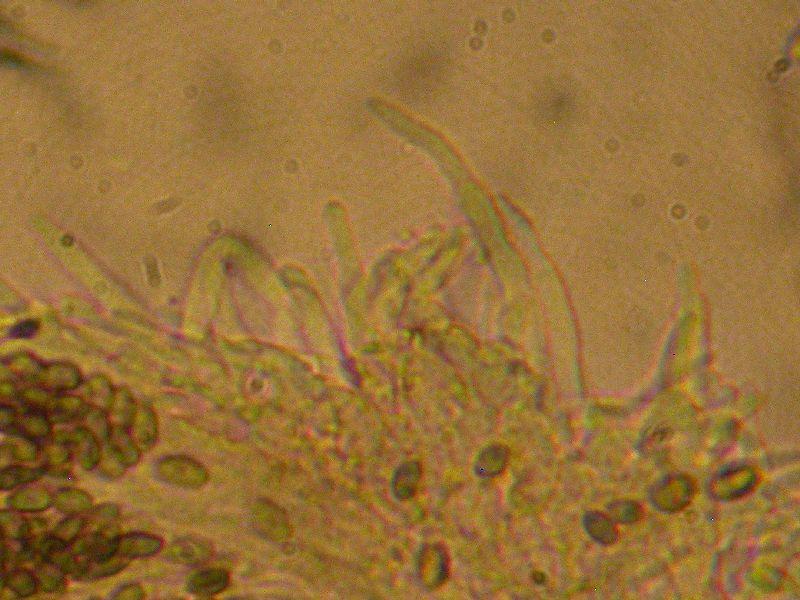
Poils marginaux jusqu'à 50 x 2,5-3,5 µm, à paroi épaisse de 0,5 µm, hyalins, non septés.
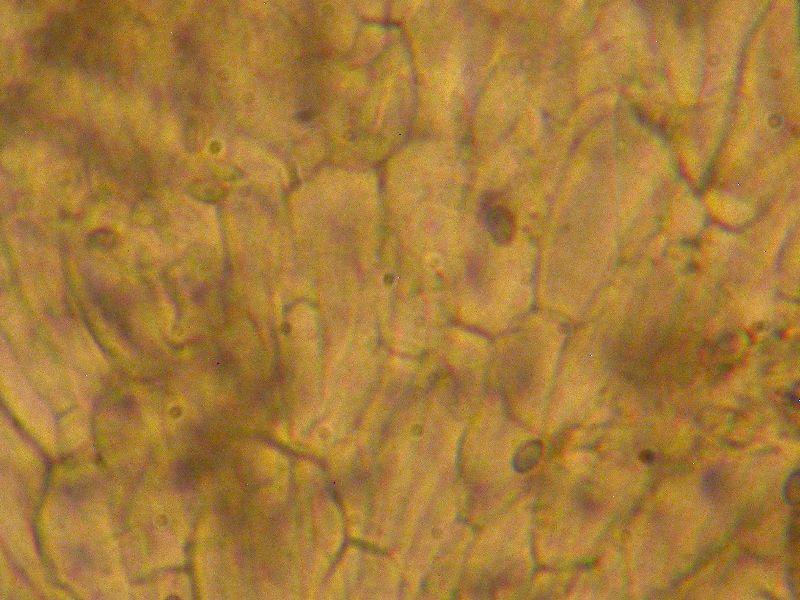
Excipulum en textura globosa-angularis hyaline de 12-25 x 8-15 µm, cellules de taille assez variable.
La zone du haut du stipe/base de la coupe présente une texture prismatica d'hyphes hyalins de 5 µm de diamètre.
Un Discomycète à l'hyménium surprenant par rapport au reste...J'ai d'abord cru qu'il était parasité.
Qu'en pensez-vous ? Merci pour vos avis
Pascal
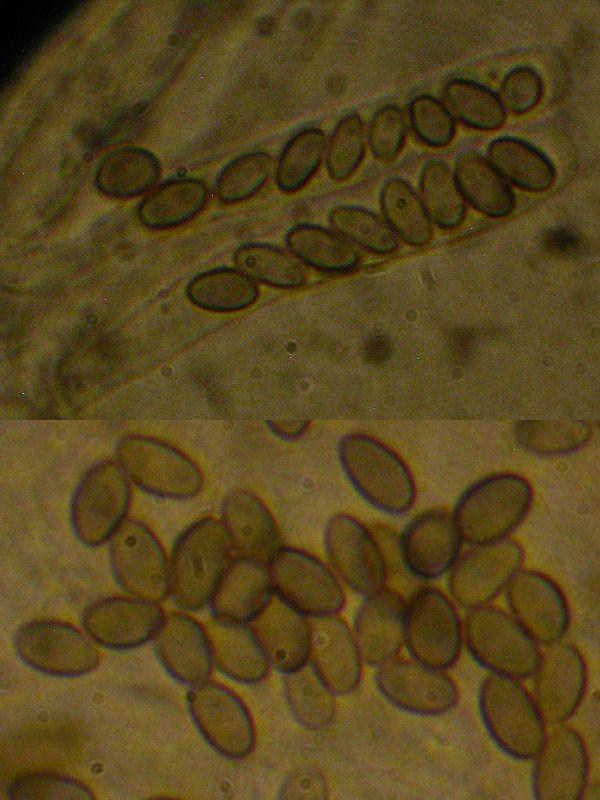
Hans-Otto Baral,
05-09-2017 09:59

Re : Discomycète sur écorce
Hi Pascal
Very interesting! Did you test the asci also with Lugol?
Perhaps a Lambertella but the spores are very small.
I assume your microscope light is too weak and also would need more blue light (blue filter). Did you ever try a strong LED below the condensor?
Zotto
Very interesting! Did you test the asci also with Lugol?
Perhaps a Lambertella but the spores are very small.
I assume your microscope light is too weak and also would need more blue light (blue filter). Did you ever try a strong LED below the condensor?
Zotto
Pascal RIBOLLET,
05-09-2017 12:33
Re : Discomycète sur écorce
Lambertella ! That seem to fit very well. I did not know the genus (only "on the books"). The synoptic key by Korf & Zhuang lead to only four species with such small spores. Within those species, Lambertella microspora (Seaver) Dumont seems to be a good lead, but I must check.
I could not test with IKI because I must renew it...
You're right for my microscope : my 30W broke and I've only found a 20W. I've to change it and also rectify the light's tone...
Many thanks Zotto !
Cheers
Pascal
I could not test with IKI because I must renew it...
You're right for my microscope : my 30W broke and I've only found a 20W. I've to change it and also rectify the light's tone...
Many thanks Zotto !
Cheers
Pascal
Hans-Otto Baral,
06-09-2017 10:29
Re : Discomycète sur écorce
Looking at the synoptic key I see that Lambertella microspora has an ascus pore turning blue in iodine. As you do not have Lugol, I suggest to do KOH-pretreatment: Put a small part of hymenium in a drop of ca. 2-5% KOH and wait a few seconds, then try to dilute the KOH with water. Remove also the water and add enough MLZ so that the preparation remains redd-brown. Add the cover glass and look for the ascus tip. (sorry when you know the procedure)
three other species would have inamyloid asci: 1, 27, 44 (acuminata, minutula, zeylanica), but all of them are simultaneoiusly listed in the J+ lead. But spore shape does not seem to fit to either species (laterally flattened, one end broader), except for microspora. zeylanica is also excluded by spores hyaline in the asci.
Zotto
three other species would have inamyloid asci: 1, 27, 44 (acuminata, minutula, zeylanica), but all of them are simultaneoiusly listed in the J+ lead. But spore shape does not seem to fit to either species (laterally flattened, one end broader), except for microspora. zeylanica is also excluded by spores hyaline in the asci.
Zotto
Pascal RIBOLLET,
08-09-2017 12:40
Re : Discomycète sur écorce
Hi Zotto,
I've done the KOH-pretreatment : no reaction at all.
In the synoptic key, tree of the four species selected on spore-size (acuminata, minutula, zeylanica) can either turn blue or not. Only microspora must turn blue.
So not microspora.
But as you wrote, zeylanica is excluded by spores hyaline in the asci and spore shape does not fit to acuminata and minutula.
I fear we can't go further than "Lambertella sp." ?
Thanks for your help !
Best
Pascal
I've done the KOH-pretreatment : no reaction at all.
In the synoptic key, tree of the four species selected on spore-size (acuminata, minutula, zeylanica) can either turn blue or not. Only microspora must turn blue.
So not microspora.
But as you wrote, zeylanica is excluded by spores hyaline in the asci and spore shape does not fit to acuminata and minutula.
I fear we can't go further than "Lambertella sp." ?
Thanks for your help !
Best
Pascal
Hans-Otto Baral,
08-09-2017 12:44
Re : Discomycète sur écorce
Yes, I do not so any solution. In the worst case your fungus is not sclerotiniaceous at all. I suspect this a bit because the excipulum is hyaline without any incrustation. Lambertella is heterogeneous and includes also Helotiaceae and other families.
Zotto
Zotto