
14-05-2026 05:36
Ethan CrensonHi all, I haven't paid much attention to Lachnu
11-05-2026 12:32
 Bernard CLESSE
Pourriez-vous m'aider à identifier cette héloti
13-05-2026 15:26
 François Freléchoux
Bonjour,Voici une récolte faite il y a quelques j
12-05-2026 15:41
 Nicolas VAN VOOREN
Dear Ascolovers, especially interested in Pezizale
13-05-2026 12:05
 Thierry Blondelle
Bonjour à tous,J'aimerais avoir confirmation de c
10-05-2026 23:17
 Andreas Gminder
Hello,today we found in a moist steep decidous for
28-04-2026 20:07
 Lothar Krieglsteiner
... on twig in the air at standing Ceratonia siliq
27-04-2026 20:52
Lothar Krieglsteiner
Found on hanging tiwg of Olea europaea in dried-ou
11-05-2026 20:22
Lothar Krieglsteiner
on attached twig of standing Ficus caricaquite uns
I found these conidia on Fagus sylvatica (a thick slice of the stem). They resemble Prosthecium pyriforme but this species is restricted to Acer.
The conidia are muriform, have a 1,5 µm thick hyaline sheath and measure 32-38 x 14-17 µm (without sheath).
Is it possible to determine the species?
Regards
Steffen
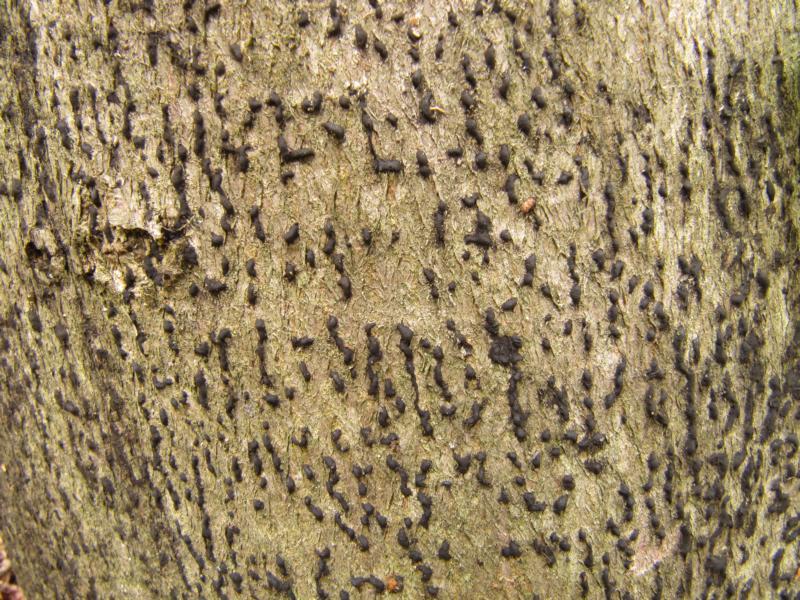
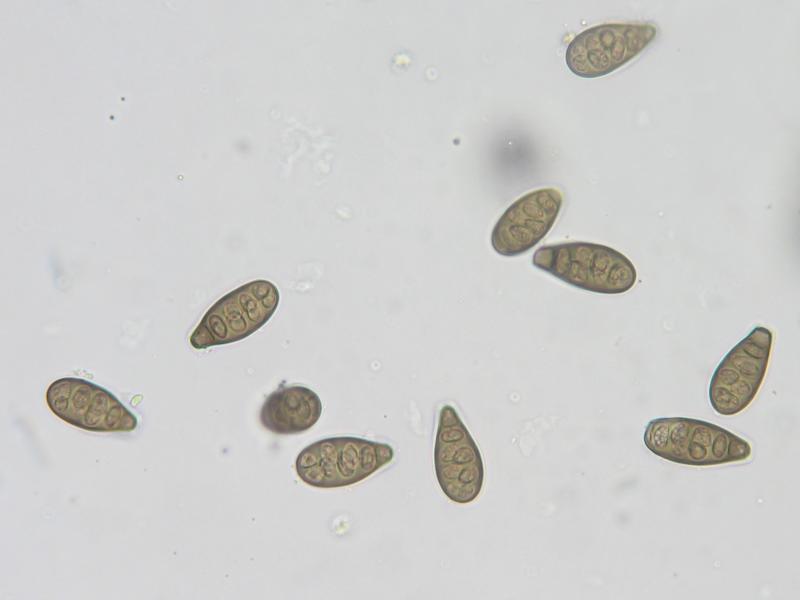

Hi Steffen,
Concerning the bark features seen in your illustration the substrate clearly is not Fagus but Acer pseudoplatanus.
So you are right, the species is from the Stegonsporium pyriforme group, there are three cryptic species which can only be reliably identified by sequence data.
See Voglmayr, H., Jaklitsch, W. M., 2014. Stilbosporaceae resurrected: generic reclassification and speciation. Persoonia 33: 61-82, available for free download at https://www.ncbi.nlm.nih.gov/pmc/articles/PMC4312938/
Hermann
thank you for your answer. I think, you are right with the substrate.
Looking at the picture I was in doupt too, but I was too sure with Fagus. On top of that the conidia seemed a bit slender (width 17-20 µm according to Ellis & Ellis). But your and Mr. Jaklitsch's article confirm my measurements.
Are you interested in this collection for your studies?
Regards
Steffen
Many thanks for your offer of the material - however, the Stegonsporium project is finished, so I don't need additional specimens.
Best wishes, Hermann