
14-05-2026 05:36
Ethan CrensonHi all, I haven't paid much attention to Lachnu
11-05-2026 12:32
 Bernard CLESSE
Pourriez-vous m'aider à identifier cette héloti
13-05-2026 15:26
 François Freléchoux
Bonjour,Voici une récolte faite il y a quelques j
12-05-2026 15:41
 Nicolas VAN VOOREN
Dear Ascolovers, especially interested in Pezizale
13-05-2026 12:05
 Thierry Blondelle
Bonjour à tous,J'aimerais avoir confirmation de c
10-05-2026 23:17
 Andreas Gminder
Hello,today we found in a moist steep decidous for
28-04-2026 20:07
 Lothar Krieglsteiner
... on twig in the air at standing Ceratonia siliq
27-04-2026 20:52
Lothar Krieglsteiner
Found on hanging tiwg of Olea europaea in dried-ou
11-05-2026 20:22
Lothar Krieglsteiner
on attached twig of standing Ficus caricaquite uns
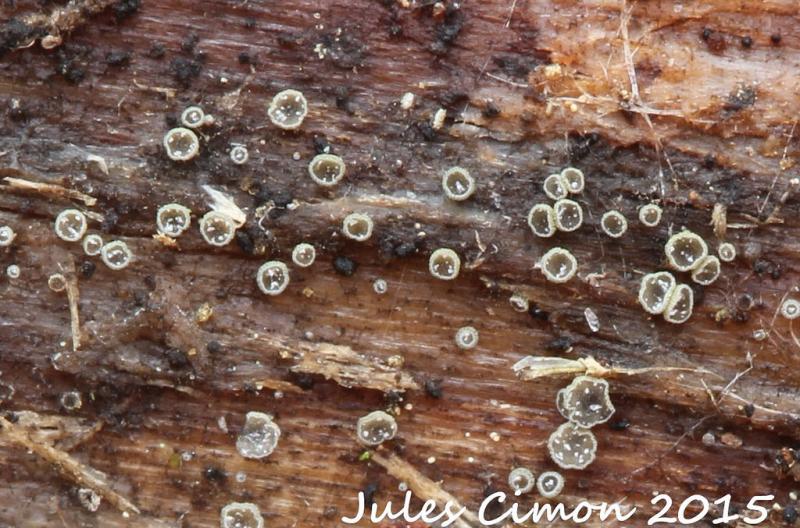
Voici un discomycète inconnu de nous.
C'est peur-être un Proliferodiscus.
Merci de nous aider dans son identification.
Roland
Données :
Apothécie courtement stipitée ou très étroitement sessile, jusqu'à 0,36 mm de diam., 0,24 mm de hauteur totale (exsiccata)
Asques cylindriques, un peu élargis sur le tiers supérieur, à 8 spores bisériées, avec crochet basal et appareil apical amyloïde, 39,7-45 x 5-6,1 µm
Paraphyses cylindriques, parfois légèrement élargies à l'apex, ramifiés à la base et parfois aussi sur la partie médiane, à contenu finement granuleux (spécimens réhydratés), 30,5- 50,1 x 1,52-1,9 µm, ne dépassant pas les asques ou très peu
Spores ellipsoïdes, parfois légèrement plus étroites à une extrémité, lisses, possiblement fugacement septées entre les 2 guttules (difficile à préciser), biguttulées, hyalines ou à réfringence verdâtre, 4,5- 5,4 x 2,2-2,4 µm, Q = 2,1
Excipulum ectal en textura porrecta, formé d'hyphes fortement gélatinisées, septées, à paroi épaissie, brunâtres, 7-18,4 x 1,9-4,8 µm
Médulla en textura intricata(?), difficile à préciser car fortement gélatinisée, formée de cellules polymorphe à subglobuleuses, 5,4-5,7 x 4,3-5,3 µm
Revêtement externe formé de cellules subglobuleuses à ellipsoïdes, hyalines, 7,3-11,6 x 5,7-7,1 µm
Poils externes cylindriques, renflés à la base, parfois légèrement élargis à l'apex, septés, à paroi légèrement épaissie, finement échinulés (?), brunâtres, couverts d'incrustations brunâtres, longs, jusqu'à 5,3 µm de diam. à l'apex, avec aspérités jusqu'à 0,5 µm de longueur
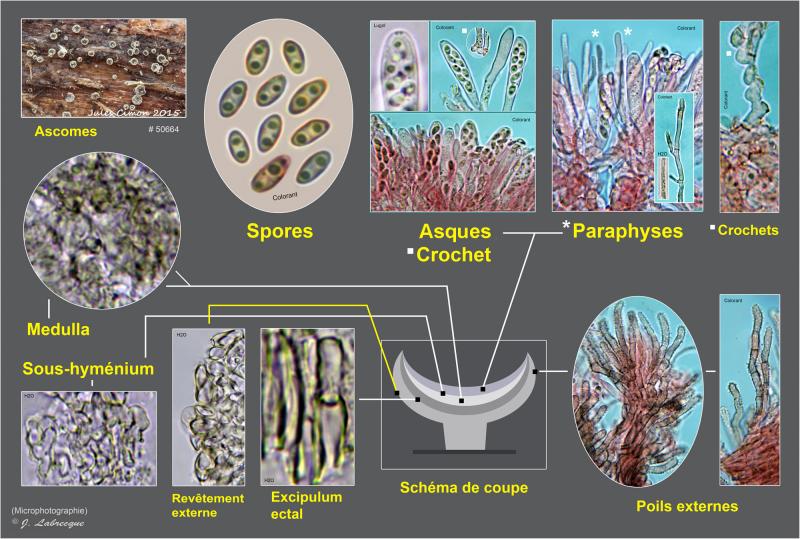

I think this is a Hyphodiscus. It resembles my H. hemiamyloideus but the drops in the spores of your fungus are too large.
the excipulum I do no really understand. I agree with your description of a strongly gelatinized t. porrrecta but the image shows a rather thin-walled porrecta. under which angle is this porrecta running?
Zotto
Comme réponse, les hyphes du textura sont verticales.
Elles suivent la courbe de la paroi en montant.
Nous ne pouvons malheureusement pas donner plus de précisions, car la texture très géléifiée rend l'observation détaillée impossible, malgré l'usage d'ammoniaque et autres.
Here an example of hyphodiscus hymeniophilus.
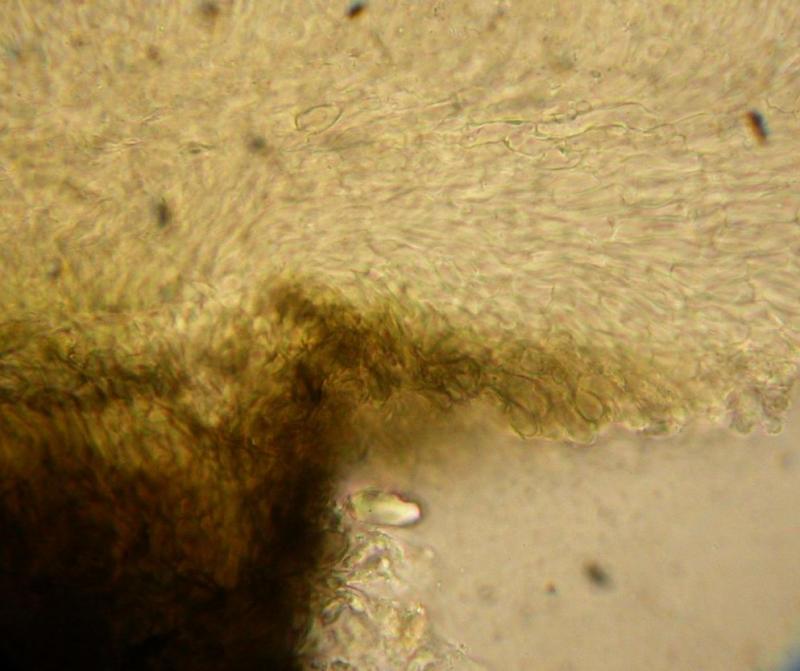
Here are three other photos.
Roland
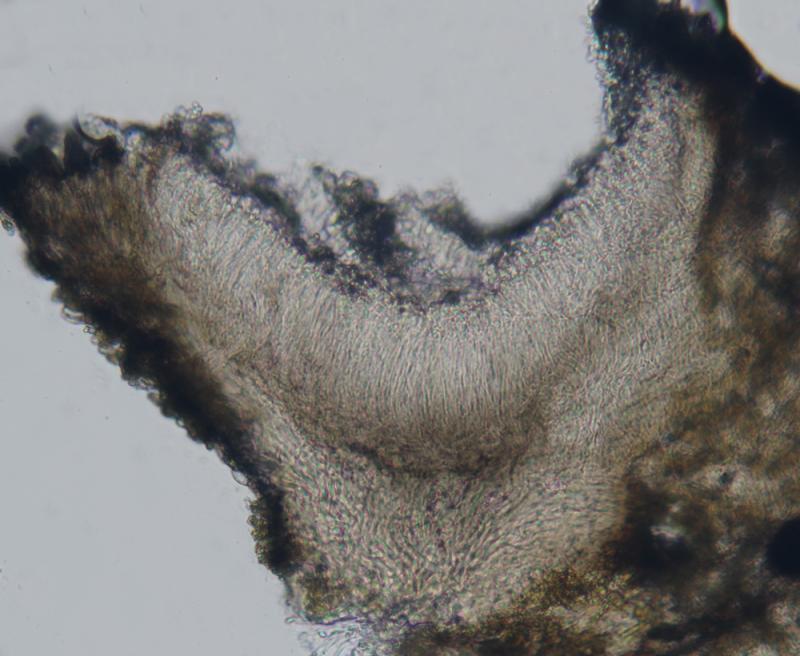
Hyphodiscus is very difficult and needs a detailed monographic study.
Zotto
Quelles sont les objections pour que ce ne soit pas H. teiodeus ?
Certains Hyphodiscus teintent leur substrat de rouge.
Serait-ce le cas pour H. teiodeus ?
Thank you !
Roland