03-05-2026 10:57
 Castillo Joseba
Me mandan el material seco de Galicia (España) re
02-05-2026 12:42
Alain BRISSARDBonjour à tousJeuidi 30 avril dernier on m'a remi
02-05-2026 13:06
Pauline. PennaBonjour Please can someone help me with this id
01-05-2026 22:45
 Thierry Blondelle
Bonjour à tous, Une récolte sur bouse séchée d
28-04-2026 20:07
 Lothar Krieglsteiner
... on twig in the air at standing Ceratonia siliq
14-04-2026 05:32
Ethan CrensonHi all, A few weeks back a friend pointed out som
28-04-2026 20:33
Vitus SchäfftleinHello, I found Trochila ilicina on Ilex aquifoliu
30-04-2026 10:28
Rot BojanHello, by appearance I would say that I am dealing
Orbilia
Patrice TANCHAUD,
06-11-2015 18:01
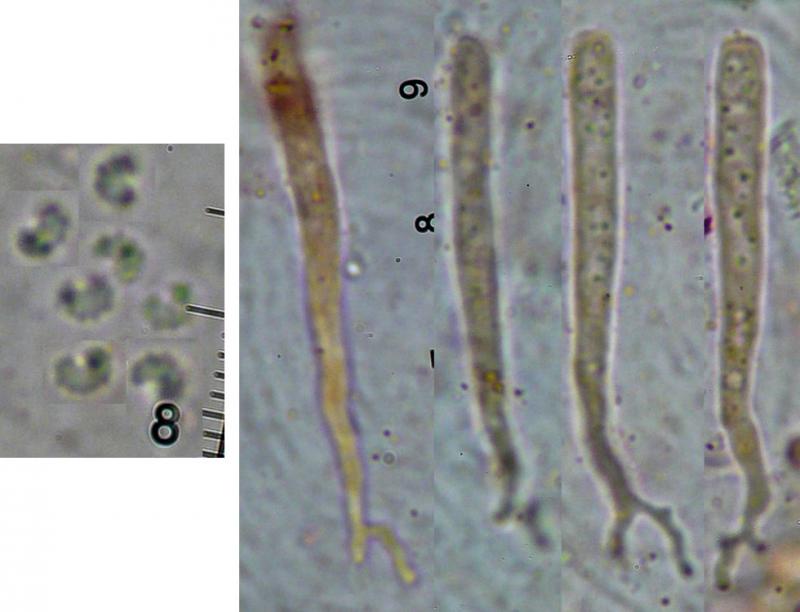
sur feuillu, spores 4,5-5,2 x 1,8-2,2 µm. Peut-être O. coccinella ?
Merci.
Patrice
 Doc1-0018.pdf
Hans-Otto Baral,
06-11-2015 18:29

Re : Orbilia
Hi Patrice
The spores look very cylindrical, quite unusual for O. eucalypti = coccinella s.auct. (typical O. coccinella is a nordic species with reniform spores).
Can you show me an ascus photo too? What is the substrate and was it on the moist ground? The colour is a bit intense, unless it grew exposed for repeated drying.
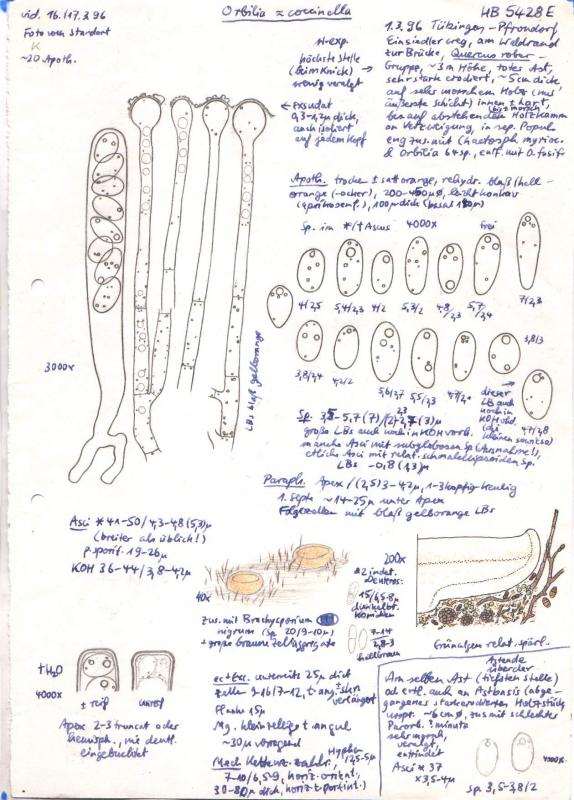
I have one collection with cylindrical spores, see below. It grew in 3 m above ground on an attached branch.
Zotto
The spores look very cylindrical, quite unusual for O. eucalypti = coccinella s.auct. (typical O. coccinella is a nordic species with reniform spores).
Can you show me an ascus photo too? What is the substrate and was it on the moist ground? The colour is a bit intense, unless it grew exposed for repeated drying.
I have one collection with cylindrical spores, see below. It grew in 3 m above ground on an attached branch.
Zotto
Patrice TANCHAUD,
06-11-2015 22:21
Re : Orbilia
Je suis désolé mais maintenant voici les spores que j'observe, il s'agit donc d'O. leucostigma. Les premières observées étaient probablement des spores parasites car je doute qu'il y ait deux espèces ici.
I'm sorry but here are the spores that I observed, it is therefore O. leucostigma. The first observed were probably parasites spores because I doubt that there are two species here.
Patrice