
06-05-2026 17:23
Thomas Læssøehttps://svampe.databasen.org/observations/10594257
06-05-2026 11:25
 Castillo Joseba
Me mandan el material seco de Galicia (España) re
28-04-2026 20:07
 Lothar Krieglsteiner
... on twig in the air at standing Ceratonia siliq
05-05-2026 22:40
Gernot FriebesHi,I believe this is a Plagiostoma growing on a Sa
04-05-2026 18:13
 Stephen Martin Mifsud
ID request for what seems to be a true aquatic fun
04-05-2026 16:39
Stephen Martin Mifsud
ID request: This specimen was collected in Malta o
28-07-2011 18:31
 Alex Akulov
Dear FriendsToday I made the pdf file of Velenovsk
04-05-2026 09:50
Castillo Joseba
Me mandan el material seco de Galicia,(España) re
02-05-2026 12:42
Alain BRISSARDBonjour à tousJeuidi 30 avril dernier on m'a remi
 Bonsoir tous
the 'foam-cakes' which can develop in fast flowing streams are a very interesting habitat for the so-called 'Ingoldian Fungi'.
Examples of some of the often distinctive conidia found can be seen here:
http://www.ascofrance.com/search_recolte/3964
http://www.ascofrance.com/search_recolte/3943
http://www.ascofrance.com/search_recolte/3010
Amongst these "aquatic hyphomycetes" one often sees diatoms and other algae, lepidopteran wing scales, pollen etc.; and also chance fungal spores from unknown fungi (which may or may not be aquatic in origin). Normally one ignores these, but occasionally one finds something so striking there may be a hope of getting an identification, even from a single spore. Here is an example of this and I am hoping that such a distinctive spore (which is surely an ascospore - Pleosporales or similar?) will be recognised by someone here. Notable are the large size of the spore and the very distinctive hyaline tips at each end (which are not formed within a single cell - the terminal cells are part-coloured). It may not be evident from the photograph, but the spore is 8-septate.
As ever any suggestions would be very welcome.
Chris
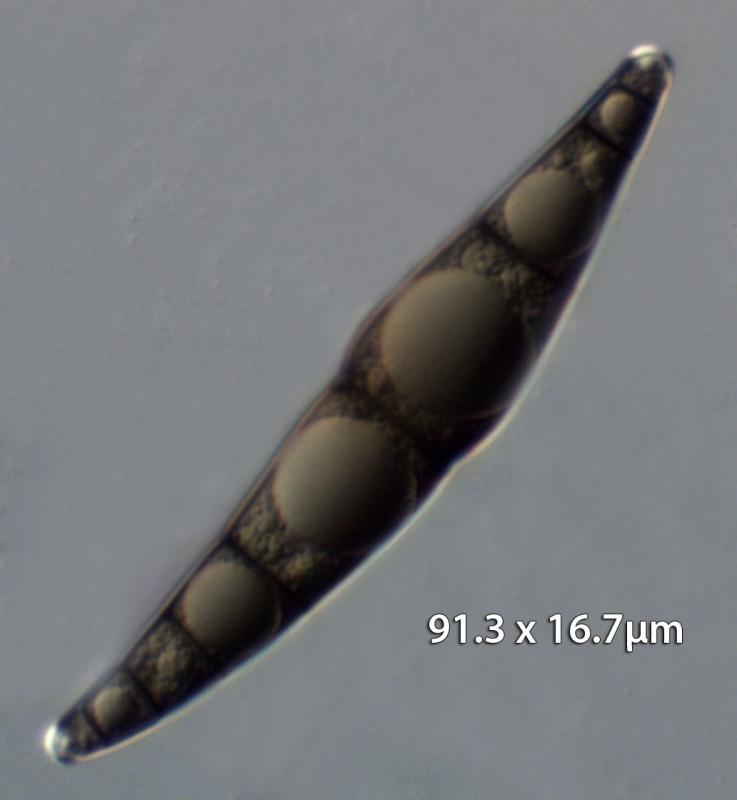
could be an ascospore of Trematosphaeria hydrela.
Best wishes,
Gernot

Exactly !
It's more common to find conidias of the anamorphic stages, ingoldian fungi, but sometimes there are ascospores of the sexual stage. One can also find non-aquatical spores.
Alain
Hi Chris and Gernot,
I fully agree with Gernot: this should be the spore of Trematosphaeria hydrela! I quite often found these species on deciduous wood in rivulets.
Regards from Lothar