
06-05-2026 17:23
Thomas Læssøehttps://svampe.databasen.org/observations/10594257
06-05-2026 11:25
 Castillo Joseba
Me mandan el material seco de Galicia (España) re
28-04-2026 20:07
 Lothar Krieglsteiner
... on twig in the air at standing Ceratonia siliq
05-05-2026 22:40
Gernot FriebesHi,I believe this is a Plagiostoma growing on a Sa
04-05-2026 18:13
 Stephen Martin Mifsud
ID request for what seems to be a true aquatic fun
04-05-2026 16:39
Stephen Martin Mifsud
ID request: This specimen was collected in Malta o
28-07-2011 18:31
 Alex Akulov
Dear FriendsToday I made the pdf file of Velenovsk
04-05-2026 09:50
Castillo Joseba
Me mandan el material seco de Galicia,(España) re
02-05-2026 12:42
Alain BRISSARDBonjour à tousJeuidi 30 avril dernier on m'a remi
Mollisia?
Steve Clements,
14-04-2015 20:34
This is one which i thought would be relatively easy as it has quite distinctive hair-like structures with dense contents cut off with a septum. However, I could find nothing like them in my books (Ellis and Ellis, FOS vol 1, Peter Thompson).
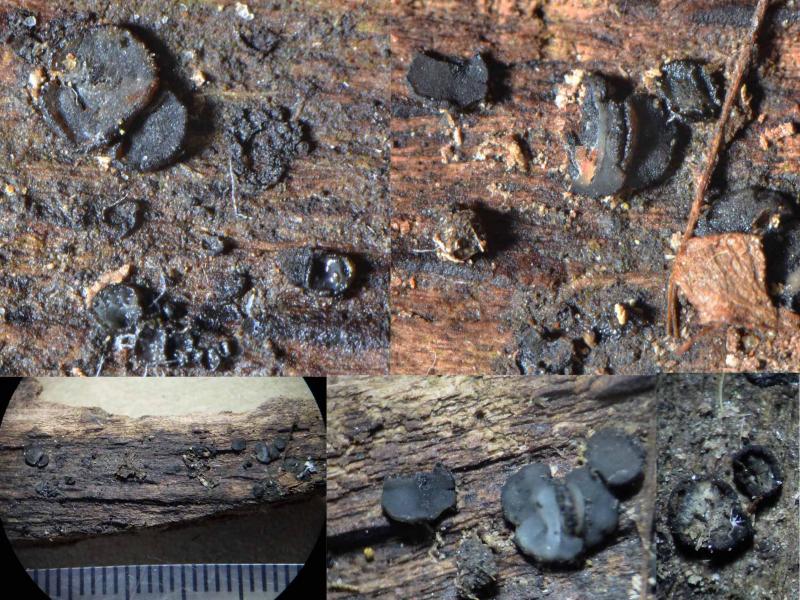
Found on very rotten wood by a stream in mixed woodland (mainly Oak , Sycamore and Hazel in vicinity, but logs washed down hillside). Apothecia very dark grey (blackish) up to 2 mm, sessile. The edge looks rather thick and rough. On drying the disc turned much paler.
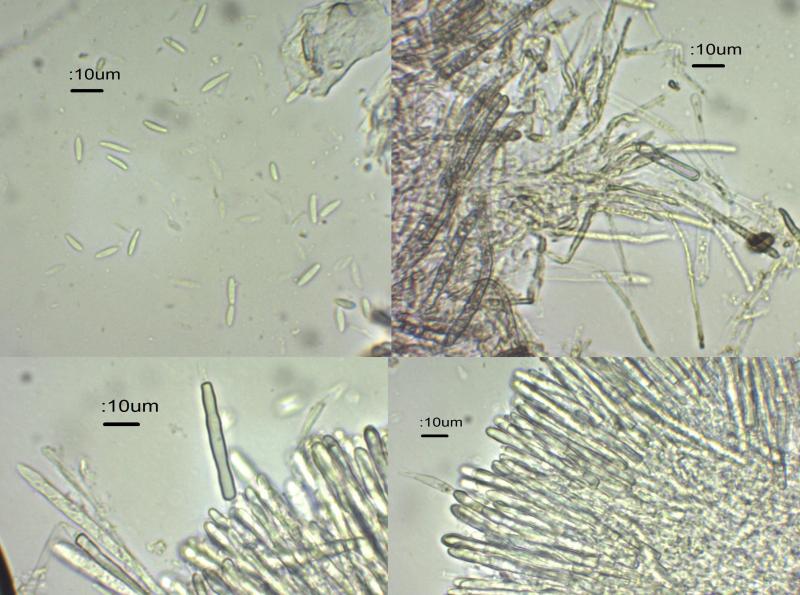
Spores 6-10 x 2-2.5, no guttules. Asci blueing with Lugol: typically 80-90 x 4. Excipular cells rounded, about 10 um across.
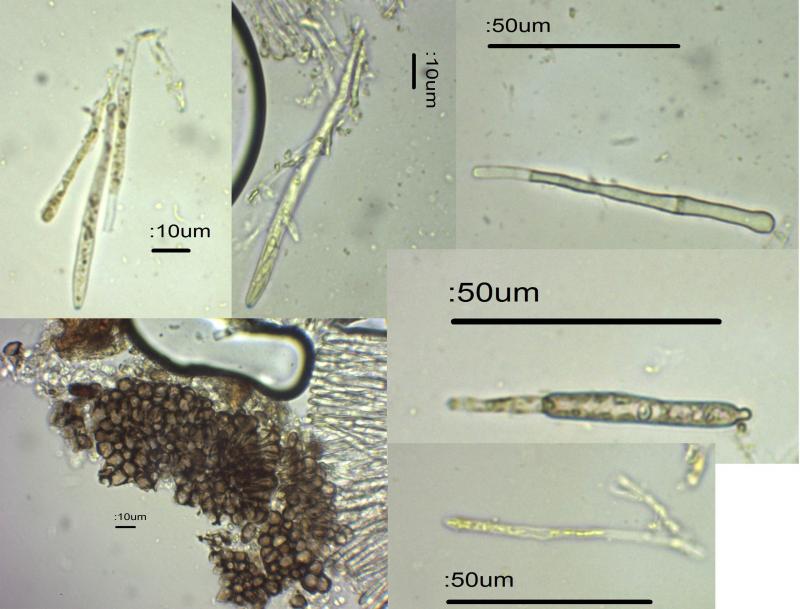
The most interesting structures were the paraphyses/hairs up to 80 x 5 (swollen tip) which contained a glassy substance, sharply cut off by a septum. Some had a nipple. However, there were also thread-like paraphyses(?) present up to 2.5 wide.
Any help at all with this - my third query from our 34th survey of the Longshaw Estate in the Peak District - would be very welcome.
Regards,
Steve
Hans-Otto Baral,
14-04-2015 21:26

Re : Mollisia?
This glassy content is a refractive vacuole (vacuolar body, VB) which occurs in every Mollisia (see images in this forum). But you see it only in the living state, therefore you saw also narrower paraphyses without.
The asci are rather long, otherwise I would say Mollisia cinerea.
You can test the KOH-reaction of these VBs. Add a small drop of 1-10% KOH to the edge of the coverslip and look whether a yellow sap extrudes in the medium (visible only for some seconds, best at 100x or 400x).
Zotto
The asci are rather long, otherwise I would say Mollisia cinerea.
You can test the KOH-reaction of these VBs. Add a small drop of 1-10% KOH to the edge of the coverslip and look whether a yellow sap extrudes in the medium (visible only for some seconds, best at 100x or 400x).
Zotto
Steve Clements,
14-04-2015 22:11
Re : Mollisia?
Many thanks Zotto - I am learning a great deal from Asco France!
Steve
Steve