
11-05-2026 12:32
 Bernard CLESSE
Pourriez-vous m'aider à identifier cette héloti
13-05-2026 15:26
 François Freléchoux
Bonjour,Voici une récolte faite il y a quelques j
12-05-2026 15:41
 Nicolas VAN VOOREN
Dear Ascolovers, especially interested in Pezizale
13-05-2026 12:05
 Thierry Blondelle
Bonjour à tous,J'aimerais avoir confirmation de c
10-05-2026 23:17
 Andreas Gminder
Hello,today we found in a moist steep decidous for
28-04-2026 20:07
 Lothar Krieglsteiner
... on twig in the air at standing Ceratonia siliq
27-04-2026 20:52
Lothar Krieglsteiner
Found on hanging tiwg of Olea europaea in dried-ou
11-05-2026 20:22
Lothar Krieglsteiner
on attached twig of standing Ficus caricaquite uns
29-04-2026 10:44
Lothar Krieglsteiner
growing at moist, drying-out soil at the side of a
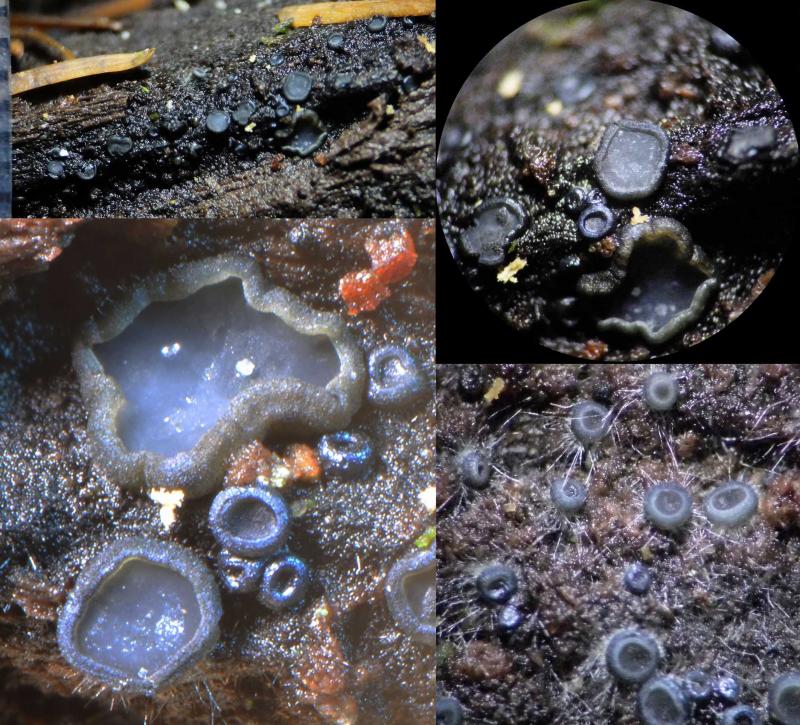
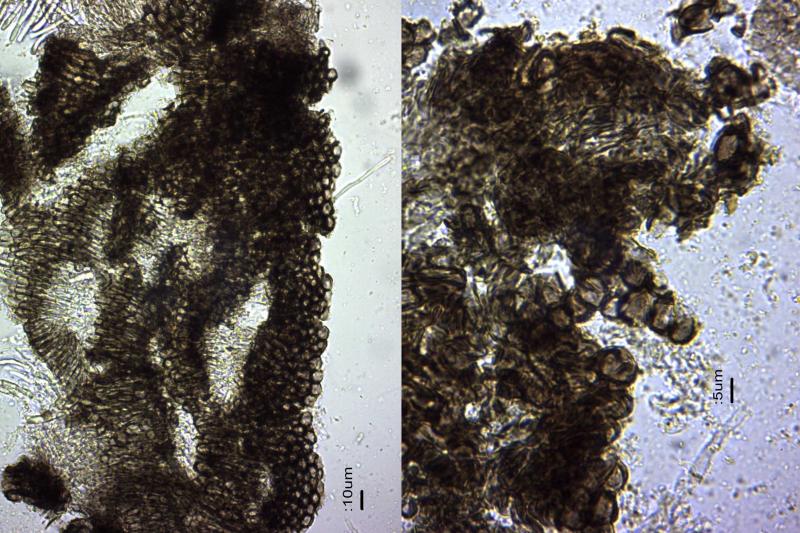
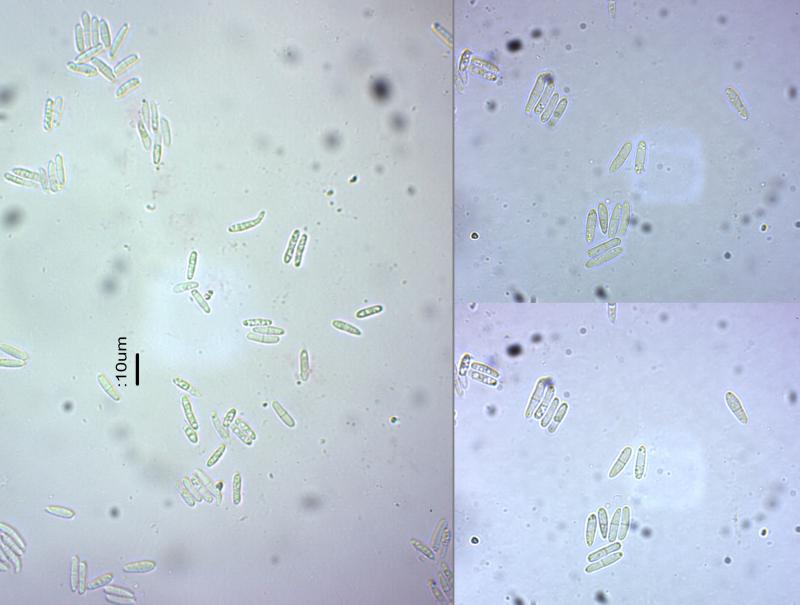
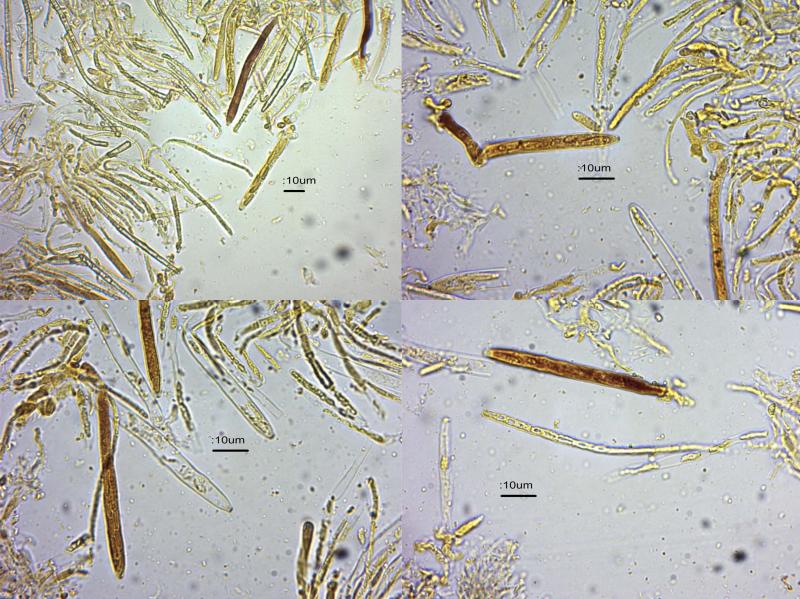
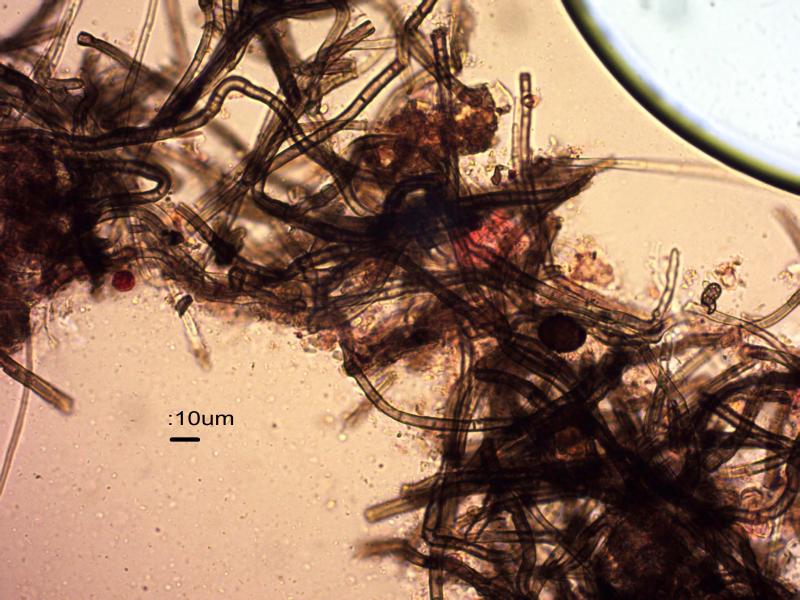
This was on damp dead wood under Larch – though it may be from another tree source as the mixed woodland is disturbed by a lot of human activity. The sessile ascocarps are up to almost 2mm diameter, rather blue-grey, only the biggest one showing yellowish tinges on the margin. After a week in the incunator there was a lot of radial hyphal growth below the cups. I was unsure whether a dark subiculum was present so I sampled the substrate between the ascocarps and found it to be composed of dark hyphae about 5 mu diameter. The spores were obtained by removing ascocarps and placing them face down on a slide overnight (otherwise the spore deposit was dominated by other ascospores from other species on the wood). They were 8-11 x approx 2.5 (some longer ones looked to have a bent extension presumably germinating hyphae). Most had a very clear septum. The asci had tips bluing in Lugol, inoperculate (?) (some views give a cap-like structure). Asci 60-70 x 5, squashing in clumps with cylindrical paraphyses 2-3 wide. Excipular cells are polygonal and 5-15 across.
I'm aware that Mollisia is a difficult genus and is getting re-sorted. From Ellis and Ellis, which I suppose is now well out-of-date for this group, I got Tapesia fusca as a possiblity, as long as the brown hyphae is a subiculum and not a Hyphomycete – but the spores should be non-septate acc. lit. Niptera has single septate spores so I also got to Niptera raminicola, but it also looks as though some Mollisia also have septate spores. Using the (anonymous?) online Mollisia key at http://www.mollisia.de/Schluessel_englisch.html I got Mollisia lividofusca based on the presumed subiculum – but this species has non-septate spores.
Any help with this difficult but common type of asco would be appreciated,
Steve

I'd class this as a Mollisia at the moment. Tapesia has been formally recognised as a synonym of Mollisia, although there are still a lot of Tapesia species not transferred to Mollisia in the nomenclature. The subiculum is not necessarily a phylogenetically stable character, even in some specific species, and there's no evidence that there's a distinct "Tapesia" clade. I'm not sure about Niptera s.s. (no sequences available as yet), but I suspect it comprise a distinct clade somewhere in the "Mollisia lineage" with some of the stranger Mollisia spp., Loramyces, and some typical Mollisia spp.
If the ascospores are consistently 1-septate, even in the asci, then I would guess this would be Andreas Gminder's provisional species Mollisia "atlantica", which is also almost certainly what Ellis and Ellis's concept of Niptera ramincola is (the real Niptera ramincola is probably something else). Mollisia "atlantica" is fairly common in the UK (or at least in Wales). I've never seen it with a subiculum though... It's a bit of an odd one phylogenetically, and needs more work.
When Mollisia does get finally properly revised at the species level (i.e. when some money becomes available to do the work), I think it should require a big collaborative group effort involving lot of redescriptions, recollections and sequencing, otherwise it'll become a horrible mess - so keep hold of your specimen and images until then!
Cheers,
Brian
Best regards,
Steve