
04-05-2026 18:13
 Stephen Martin Mifsud
ID request for what seems to be a true aquatic fun
04-05-2026 16:39
Stephen Martin Mifsud
ID request: This specimen was collected in Malta o
28-07-2011 18:31
 Alex Akulov
Dear FriendsToday I made the pdf file of Velenovsk
28-04-2026 20:07
 Lothar Krieglsteiner
... on twig in the air at standing Ceratonia siliq
04-05-2026 09:50
 Castillo Joseba
Me mandan el material seco de Galicia,(España) re
02-05-2026 12:42
Alain BRISSARDBonjour à tousJeuidi 30 avril dernier on m'a remi
02-05-2026 13:06
Pauline. PennaBonjour Please can someone help me with this id
01-05-2026 22:45
 Thierry Blondelle
Bonjour à tous, Une récolte sur bouse séchée d
14-04-2026 05:32
Ethan CrensonHi all, A few weeks back a friend pointed out som
i am currenly working with collection of Perithecia-forming species inhabiting Andromeda leaf litter. My orientation in the systematic space of this group is still poor. Could you possibly give me a clue on approximate position of this representative?, it seems beautiful and distinctive one.
On fallen leaves of A. polifolia, C. calyculata, L. palustre in raised bog community.
Ascomata scattered on both sides of the leaf, sphaerical, superficial, setose around the pore, and with descending hyphae in lower part, up to 150 mk in diameter.
Setae brown, septate, thick-walled, straight and short near the pore, bent and longer outward, 40-80 mk long, 8 mk broad at base, narrowing to obtuse tip; descending hyphae brown, septate, about 1 mk broad; asci clavate, attached to stalks which connected together in bunches, 20–23 x 8–9.6 mk, dehiscence mode unclear; hamathecium from elongated thin elements surrounded by gelatinous substance; spores hyaline, two-celled, with deep constriction, with many small to medium oil guttules, measured in vital state 10 (9–1.8) x 3.5 (3.3–3.9) mk (n=22).
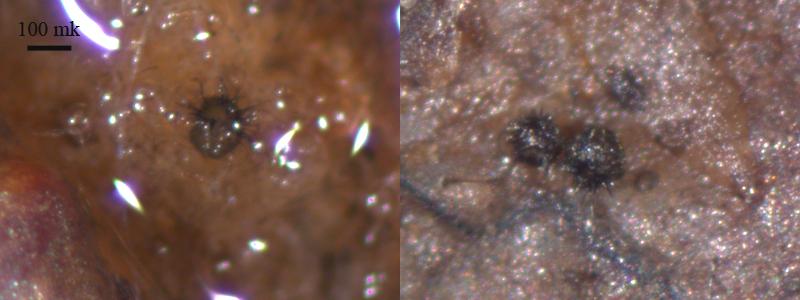
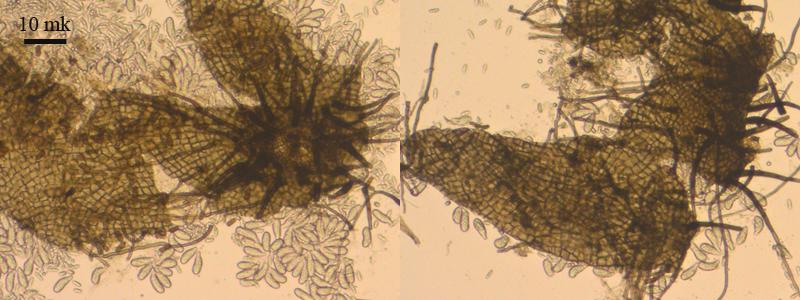
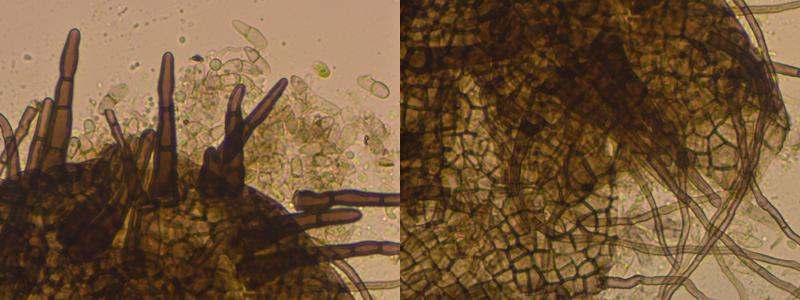
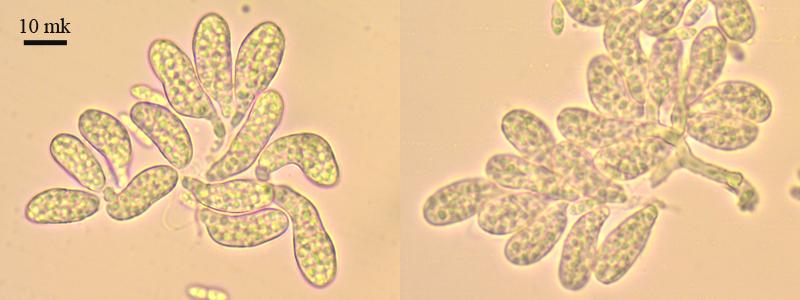
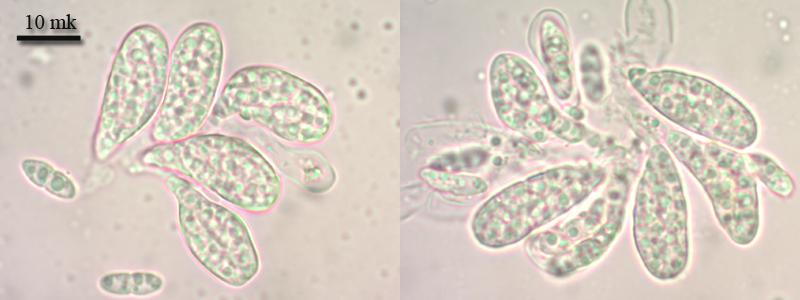
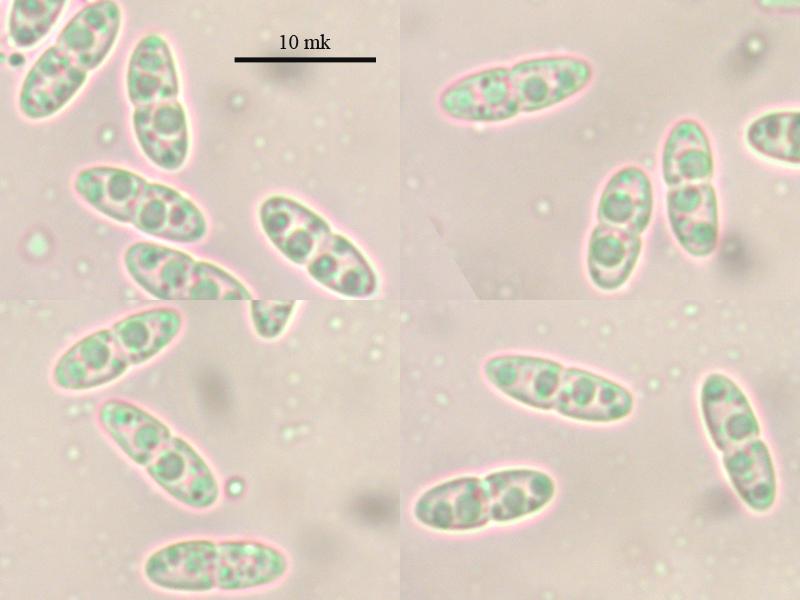
i am still searching any information about this taxon. It is puzzling ). It may belong to Mycosphaerellaceae because absence of paraphyses, two-celled hyaline spores and fasciculate asci. But i could not decide any precisely about genus and species.
Nina.

Check von Arx and Müller (1975) Studies in Mycology n°9 (available here: http://www.cbs.knaw.nl/index.php/studies-in-mycology/378-studies-in-mycology-no-9).
Did you noticed the presence of superficial hyphae too? Could be a Wentiomyces or Epipolaeum species, but the habitat is uncommon and both are more frequently found on live leaves. Aditionally, Epipolaeum has coloured ascospores, and your specimen appears to be hyaline, at least initially.
Good luck.