27-04-2026 20:52
 Lothar Krieglsteiner
Found on hanging tiwg of Olea europaea in dried-ou
28-04-2026 22:51
 Bernard CLESSE
Bonsoir à toutes et tous,Pourriez-vous m'aider à
29-04-2026 08:01
Lothar Krieglsteiner
... on twig attached to small tree of Citrus auran
29-04-2026 10:44
Lothar Krieglsteiner
growing at moist, drying-out soil at the side of a
28-04-2026 20:33
Vitus SchäfftleinHello, I found Trochila ilicina on Ilex aquifoliu

28-04-2026 21:50
 Pablo Sandoval
Hola a todos,Espero se encuentren bien. Hace mucho
27-04-2026 18:05
Lothar Krieglsteiner
... still attached at standing tree. The green con
28-04-2026 20:07
Lothar Krieglsteiner
... on twig in the air at standing Ceratonia siliq
27-04-2026 18:48
Tony MoverleyCollected 23rd April 2026, Norfolk, EnglandSwarms
Cryptosphaeria question
Chris Yeates,
30-12-2014 19:08
 Bonsoir tous
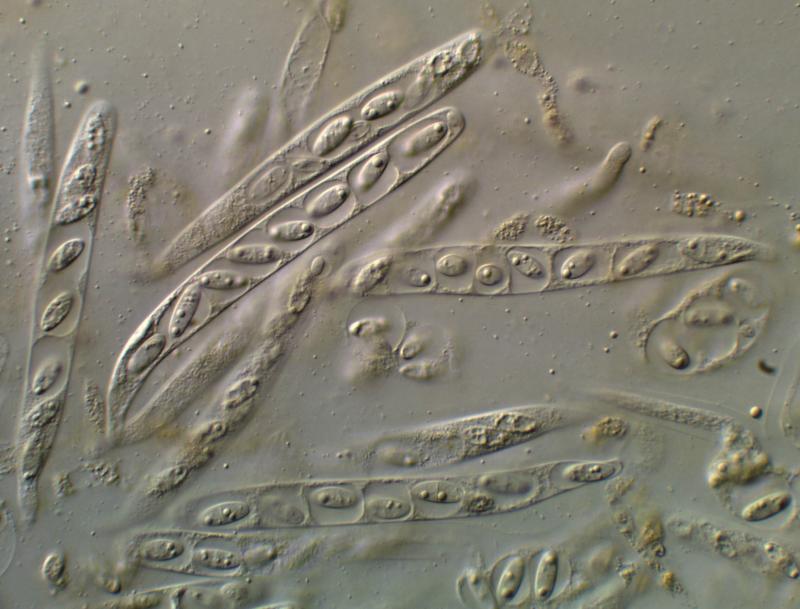
recently while preparing a 'portrait' (see below) of the common Cryptosphaeria eunomia I noticed something which may be well-lnown but I have been unable to find any reference to it. Those who study this fungus may well know that at one stage of development of the asci they assume a ventricose shape, with a swollen central section, as the spores develop.
I noticed on this occasion that at a certain point in the ascospore development they can be clearly seen to have gel sheaths or some equivalent which separate them from their comrades in chambers, rather like clustered bubbles. This can be seen particularly in the middle right image, where the spores are mostly "end-on".
With my inadequate French I have tried to find a reference to this in this or related Diatrypaceae in Rappaz, but I have perhaps missed the obvious. If this is a well-known phenomenon I apologise for wasting people's time - have others noticed this?
Cordialement
Chris
 Cryeun0b-0001.pdf
Paul Cannon,
31-12-2014 15:00
Re : Cryptosphaeria question
No easy answers, but I noted that Laessoe & Spooner (Kew Bull. 49: 56, 1993) remarked that "The present illustration of C. eunomia (Fig. 5E in their paper) shows two distinct spore types. Although this may be an abnormal situation in the species, it clearly demonstrates its ability to produce such spores".
So it seems that the species is fairly undisciplined in its spore production. I've not seen samples like you illustrate and I'm not aware of any previous reports of gelatinous sheaths. It's tempting to dismiss such events as artefacts, but it would be interesting to recollect from the same site in the spring to establish whether this is a constant phenomenon or something caused by environmental factors such as frost.
So it seems that the species is fairly undisciplined in its spore production. I've not seen samples like you illustrate and I'm not aware of any previous reports of gelatinous sheaths. It's tempting to dismiss such events as artefacts, but it would be interesting to recollect from the same site in the spring to establish whether this is a constant phenomenon or something caused by environmental factors such as frost.
Martin Bemmann,
31-12-2014 22:47

Re : Cryptosphaeria question
Dear Chris,
consider these are mature spores in a documentation of Enrique:
http://www.asturnatura.com/fotografia/setas-hongos/cryptosphaeria-eunomia-var-fraxini-richon-rappaz-2/12619.html
www.asturnatura.com/fotografia/setas-hongos/cryptosphaeria-eunomia-var-fraxini-richon-rappaz-2/12619.html
and here some of C. exornata etc.:
http://www.mapress.com/phytotaxa/content/2014/f/p00186p270f.pdf
In both cases I would tend to see a gelatinous sheath around the spores that maybe is in the state of development with unmature spores in your case.
Regards
Martin
consider these are mature spores in a documentation of Enrique:
http://www.asturnatura.com/fotografia/setas-hongos/cryptosphaeria-eunomia-var-fraxini-richon-rappaz-2/12619.html
www.asturnatura.com/fotografia/setas-hongos/cryptosphaeria-eunomia-var-fraxini-richon-rappaz-2/12619.html
and here some of C. exornata etc.:
http://www.mapress.com/phytotaxa/content/2014/f/p00186p270f.pdf
In both cases I would tend to see a gelatinous sheath around the spores that maybe is in the state of development with unmature spores in your case.
Regards
Martin
Chris Yeates,
11-01-2015 21:32
Re : Cryptosphaeria question
Perhaps this phenomenon is common to many 'pyrenomycetes'. I noticed this while examining developing Melanconis stilbostoma asci.
Chris
Chris