
06-05-2026 11:25
 Castillo Joseba
Me mandan el material seco de Galicia (España) re
06-05-2026 17:23
Thomas Læssøehttps://svampe.databasen.org/observations/10594257
28-04-2026 20:07
 Lothar Krieglsteiner
... on twig in the air at standing Ceratonia siliq
05-05-2026 22:40
Gernot FriebesHi,I believe this is a Plagiostoma growing on a Sa
04-05-2026 18:13
 Stephen Martin Mifsud
ID request for what seems to be a true aquatic fun
04-05-2026 16:39
Stephen Martin Mifsud
ID request: This specimen was collected in Malta o
28-07-2011 18:31
 Alex Akulov
Dear FriendsToday I made the pdf file of Velenovsk
04-05-2026 09:50
Castillo Joseba
Me mandan el material seco de Galicia,(España) re
02-05-2026 12:42
Alain BRISSARDBonjour à tousJeuidi 30 avril dernier on m'a remi
 Hello everyone,
Collected on a decorticated branch of Quercus robur here in Belgium:
Ascomata superficial to slightly immersed, subglobose, 0,1-0,15 mm diam., papillate, pale brown, covered by black setae. Asci cylindrical, apex truncate, 8-spored but mostly observed with 16 part-spores, 42-47x6 µm. Spores fusiform, constricted 1-septate, soon disarticulating in part-spores; part-spores ellipsoid to wedge-shaped, smooth, hyaline, 3-3,5x1,5-2 µm. Paraphyses soon disappearing. Ectal excipulum of pale brown, small-celled textura ?epidermoidea; setae acute, base swollen, smooth, thin-walled, aseptate, blackish, 39-56x7-10 µm.
With those Hypocrea-like spores, this must be a Melanopsammella? Unfortunately, I only have documentation of species with septate hairs.
Your help is welcome.
Bernard
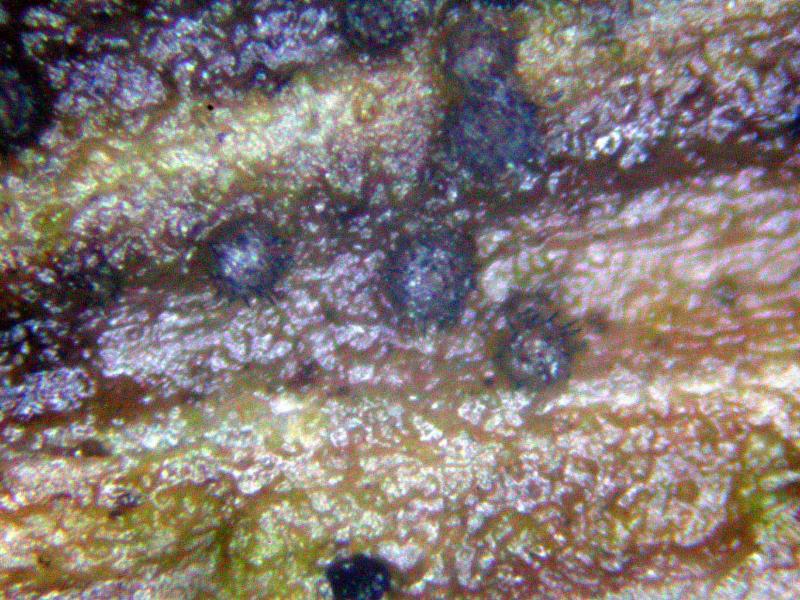
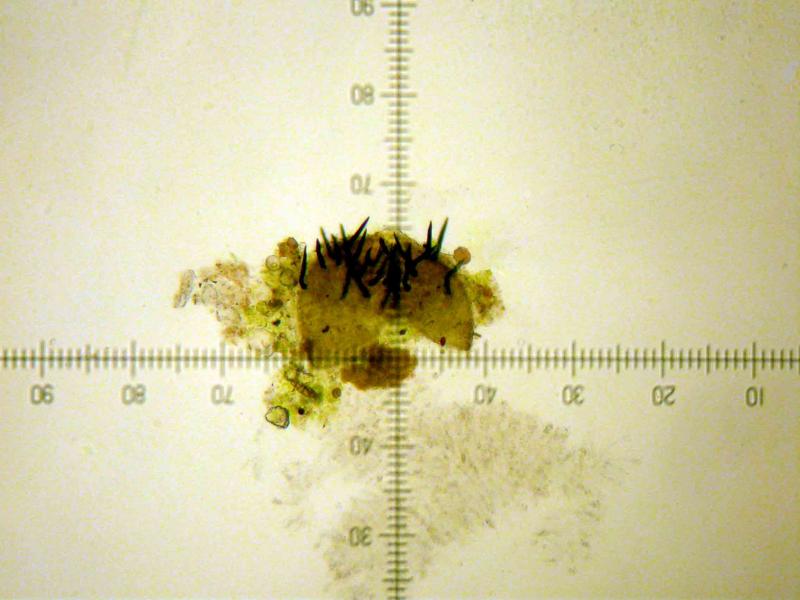
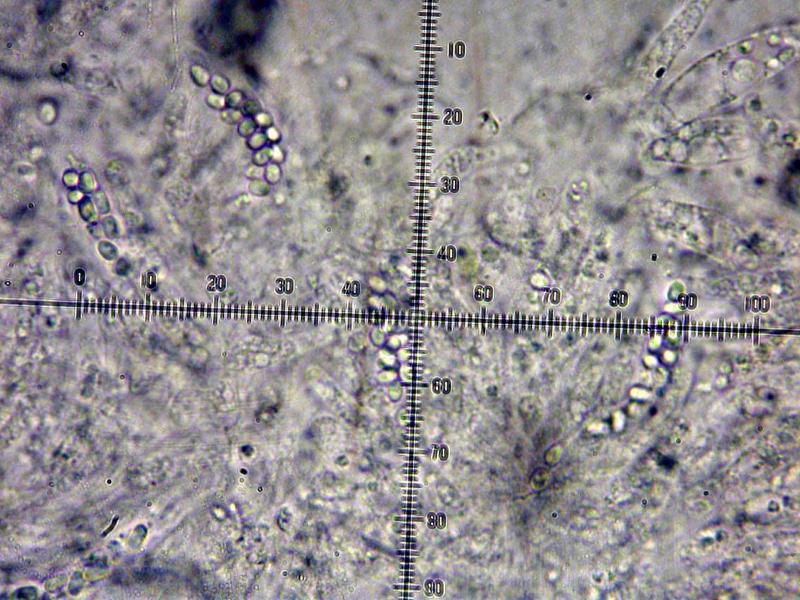
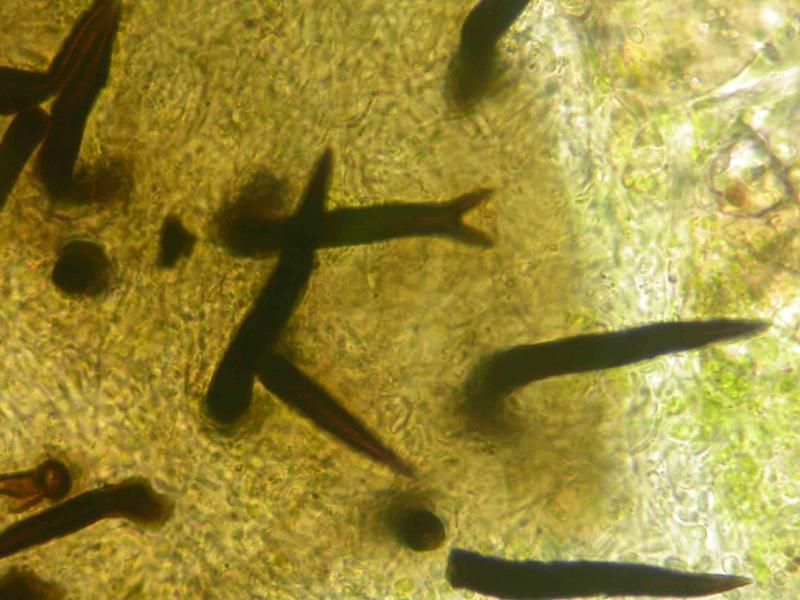

this reminds me strongly of Trichosphaerella decipiens, with apically acute, mainly unbranched setae. But what I know under that name (on Peniophora) has globose, finely warted spores.
But Ellis & Ellis (pl. 1193 in centre of plate) figure elongate spores.
Similar is Neorehmia ceratophora, with antler-like setae and also globose warted spores.
Zotto

Hi to everybody
This collection of a Trichosphaerella/Melanopsamella species on decorticated wood of Sambucus nigra seems to be very close with Bernard's collection on Quercus.
Has someone more suggestions about it?
Thanks again
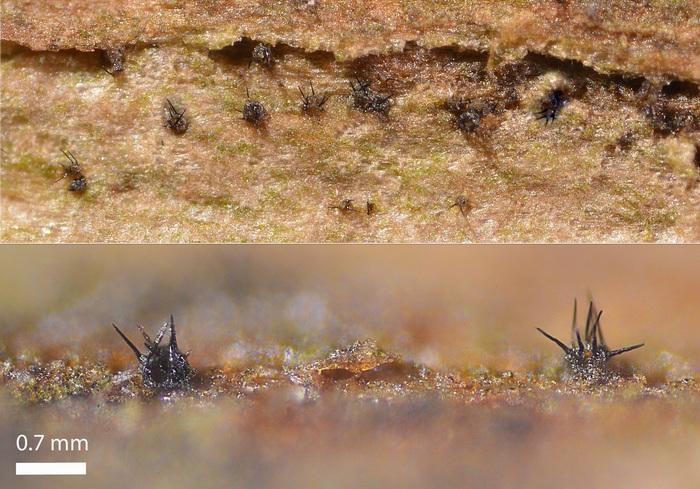
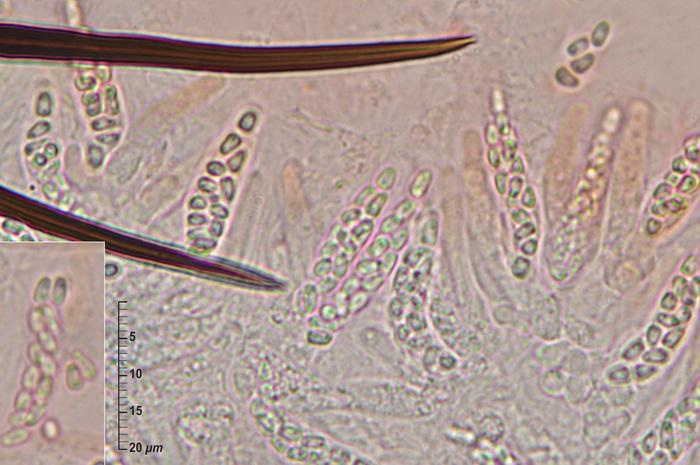
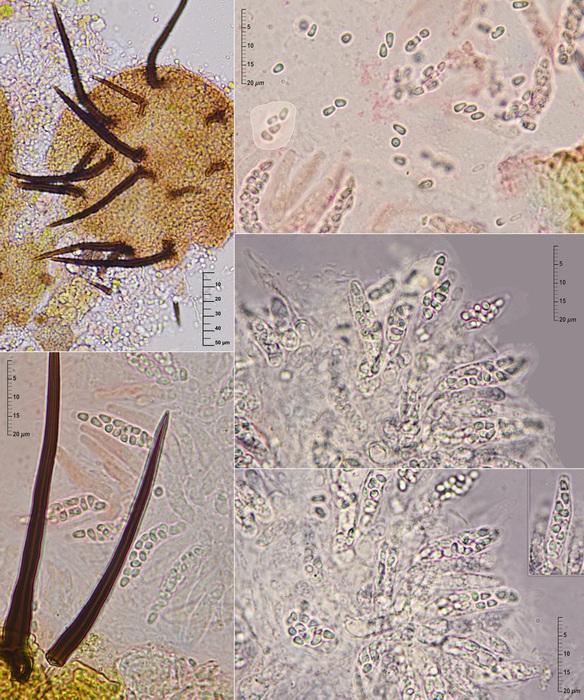
I fear that nobody will see your posting except me and Bernard?
Has someone this article? Samuels & M.E. Barr (1998) Notes on and additions to the Niessliaceae (Hypocreales): Can. J. Bot. 75(12): 2166 ['1997']
Maybe it could help us...
Le voilà.
Amitiés, Guy
 Samuels-amp-Barr-CJB-75-2165-2176-1998-0001.pdf