
12-06-2026 14:50
 François Freléchoux
Bonjour, Voici la brève description d'une Mollis
10-06-2026 21:16
François Freléchoux
Bonsoir,Le dernier du jour, en attendant votre avi
11-06-2026 19:01
 William Slosse
Hello all,In an attempt to make a culture of a sus
11-06-2026 19:03
 Nicolas VAN VOOREN
Chers membres d'Ascofrance,Le site sera placé en

09-06-2026 18:32
Camille MertensSur morceau de roseau immergé 0,5 - 0,7 mm de dia
10-06-2026 12:54
Steve ClementsBonjour encore, Pouvez-vous m'aider, s'il vous pl
10-06-2026 21:07
François Freléchoux
Toutes les tiges de gentianes jaunes de l'an passÃ
10-06-2026 13:41
François Freléchoux
Bonjour à nouveau, Voici une trouvaille d'hier.
I hope someone can help me identifying the following species of ?Pleospora?
Substrate: A small completely decorticated branch of deciduous wood (most probably Salix sp.). The branch was found along a river bank and was probably watersoaked for a longer time period.
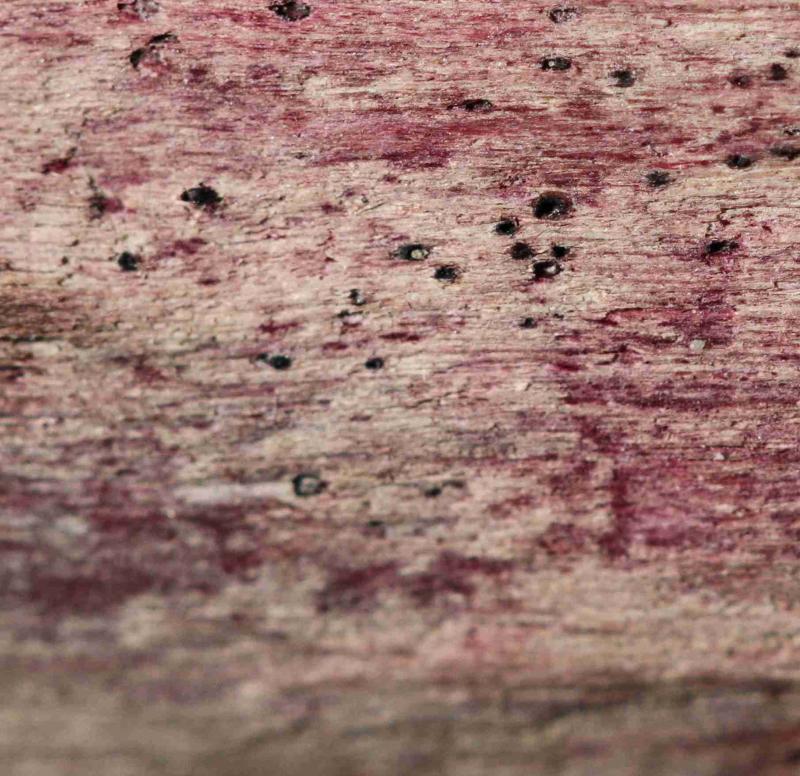
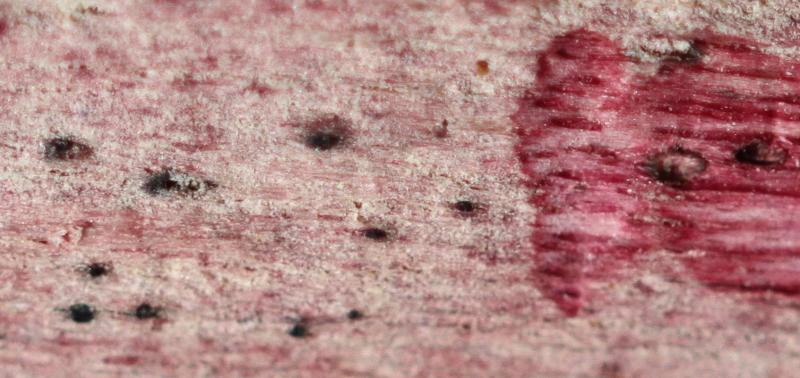
Macroscopic description: The small, scattered black ascomata are immersed in the host tissue and the wood is coloured vividly red in the Regions where ascomata are present. ascomata are slightly prolonged in wood direction and thus ellipsoid in side view, length about 450 µm and height and breadth about 300 µm. The small, round porus is difficult to see.
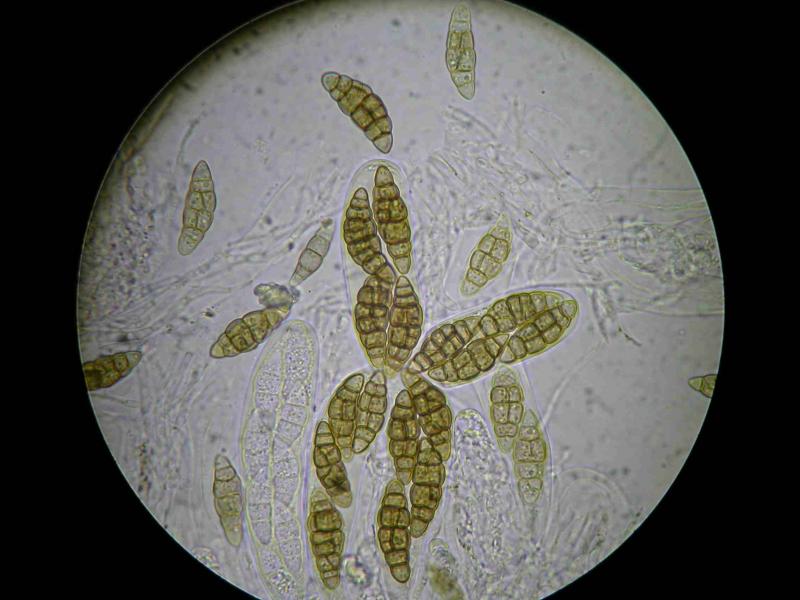
Microscopic description: Asci are usually 120-150 x 19-21 µm. Spores are yellowish brown with 5-7(-9) transversal septa. 1(-2) cells on each Spore end have no longitudinal septum. The inner spore cells are irregularly 1-2 times longitudinally septate. Spore size is fairly constant with 28-30 x 9-10 µm. Branched pseudoparaphyses of about 1 µm diameter are present.
Thank you for any help
Stefan

sorry I was away and I missed your post.
Such aquatic Pleosporales with dictyospores that stain the wood purple are genetically distant from true Pleospora species and they are now accommodated in the new genus Murispora (Zhang et al, 2009, Studies in Mycology 64).
I think i recognize the ascospores of your collection, they likely belong to a species that is widespread in France and most likely elsewhere in Europe as shown by your record. It is still unnamed and there are many other similar aquatic species that need to be evaluated and compared with terrestrial ones.
I would be happy to study your collection if you kept it.
Cheers,
Jacques
Jacques Fournier
Las Muros
F 09420 Rimont
Thanks a lot for your reply. This is very interesting. I will send you some material I have left. Probably not in the best state.
Stefan