
27-04-2026 20:52
 Lothar Krieglsteiner
Found on hanging tiwg of Olea europaea in dried-ou
27-04-2026 18:48
Tony MoverleyCollected 23rd April 2026, Norfolk, EnglandSwarms
27-04-2026 17:41
Lothar Krieglsteiner
.. Algarve, same leaf than the last post. The con
27-04-2026 18:05
Lothar Krieglsteiner
... still attached at standing tree. The green con
27-04-2026 17:16
Lothar Krieglsteiner
.. Algarve, moist lying.The conidiomata look like
27-04-2026 12:54
Steve ClementsBonjour. Ce petit champignon blanc résupiné et
27-04-2026 09:59
Pauline. PennaBonjour Can anyone advise me on these pycnidia fo

22-04-2026 20:54
 Enrique Rubio
Hi to everybody.This Pyrenopeziza grew in moist le
I could need some help with this Pyreno on most probably Alnus wood.
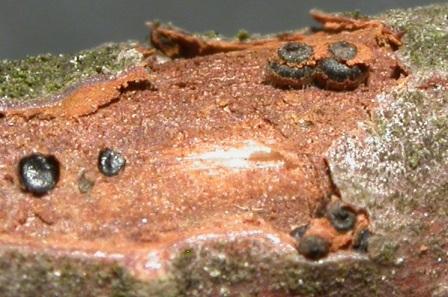
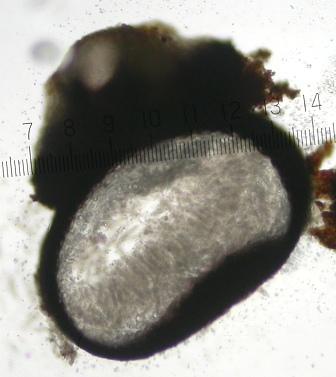
Description: Perithecia immersed below the Cortex, only visible as small bumps on the surface, sometimes pore just visible as Cortex cracks open. Perithecia with an ovoid lower part of about 0.5-1 mm in width and a height of about 0.5 mm. The upper part is disc like or semiglobous, consisting of dense black tissue with a pore in the middle. For the photo I removed the Cortex
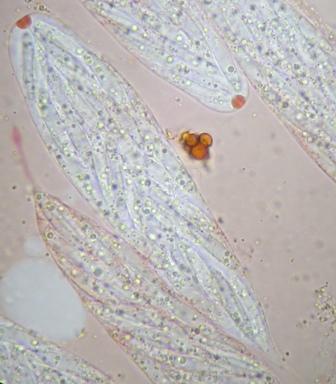
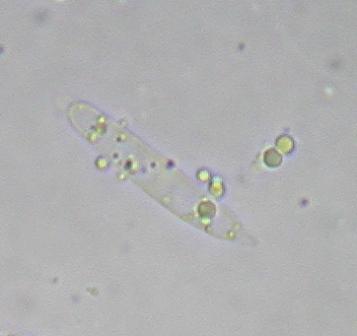
Microscopy: The most interesting feature is the Ascus with many Spores. It's more than 20 spores and I counted about 25 to 35 but counting was very difficult. I think it's 32- spored. The Apical apparatus is very well visible and coloured in Kongo and roundish (picture) but doesn't react in Iodine. I'm not sure whether the Spores are mature and I guess probably not. Spores were completely hyaline, nonseptate and 20-24 x 3.5-4.5 micrometers with blunt appendixes of about 1-2 micrometers of length. These appendixes were only observed in water (still difficult to see!) and could not be detected in KOH, Kongo or Iodine. Sometimes there seemed to be a slime sheath around the Spores, however this was only observed very infrequently.
Thank you for any help
Stefan
?

it could be Ditopella ditopa. If you want, send me, I am interested in it (it seems as if you are good in finding rare pyrenos :D ).
regards,
björn
I came by Ditopella when looking in the Ellis book. However I have more than 16 spored Asci (constantly) and never seen a septate Spore (which could be because of immature Spores) and appendages as I've seen them were also not described in Ellis. Do you have another description of Ditopella which includes those features?
Danke und lieber Gruss
Stefan
yes, I also think it should be the Ditopella. I have a description in BARR 1978: "Asci 16 to 24 spored" and ROSSMAN 2007, who describes D. ditopa as an 8-spored species.
Species with a variability in number of spores in Asci are not rare in Diaporthales (see Valsa nivea, for example). I think your finding is imature and does not show septated spores ;)
regards,
björn
PS: if you wish to have something about Diaporthales, tell me.
regards,
björn
Many thanks for the help. I think the identification is settled.
bye
Stefan
hmm better to do sequencing i think
Can you send me a peace of specimens
Thanks
Hiran