
27-04-2026 20:52
 Lothar Krieglsteiner
Found on hanging tiwg of Olea europaea in dried-ou
27-04-2026 18:48
Tony MoverleyCollected 23rd April 2026, Norfolk, EnglandSwarms
27-04-2026 17:41
Lothar Krieglsteiner
.. Algarve, same leaf than the last post. The con
27-04-2026 18:05
Lothar Krieglsteiner
... still attached at standing tree. The green con
27-04-2026 17:16
Lothar Krieglsteiner
.. Algarve, moist lying.The conidiomata look like
27-04-2026 12:54
Steve ClementsBonjour. Ce petit champignon blanc résupiné et
27-04-2026 09:59
Pauline. PennaBonjour Can anyone advise me on these pycnidia fo

22-04-2026 20:54
 Enrique Rubio
Hi to everybody.This Pyrenopeziza grew in moist le
Nectria on Frangula alnus
Björn Wergen,
27-07-2011 13:59
 Hi,
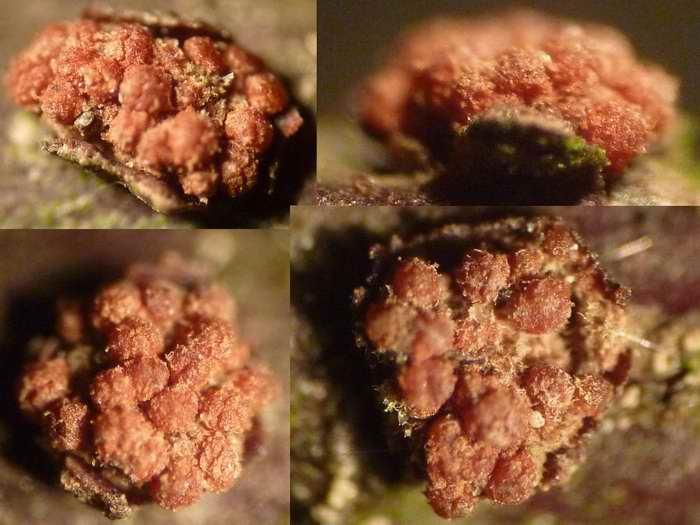
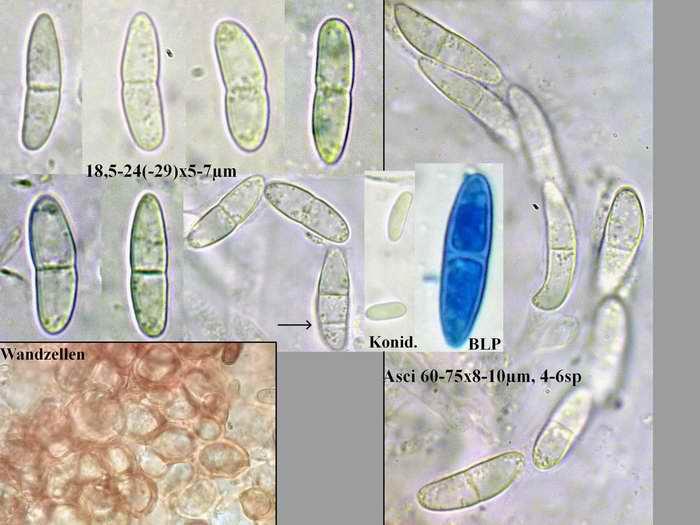
Hi,yesterday I have found a new Nectria on dead Frangula-twigs. It has very large spores with a length sometimes over 25 µm. The fruitbodies are clustered on a Stroma which seems not to be well developed, perithecia are about 0,2-0,4 mm and pale red to orange-red oder orange-brown.
The interesting fact is, that the asci have almost only 4 or 6 spores. I didn't see any asci with 8 spores. Spore ornamentation seems to be smooth, without striae. I will add some photos here, perhaps someone can help me with this or at least with a good nectria-key (I have only one key with striae-spored nectria...)
best regards,
kazuya
Björn Wergen,
27-07-2011 15:01
Re : Nectria on Frangula alnus
note: I think the small spores are "secondary spores", aren't they? I had called them "conidia spores"...
Christian Lechat,
27-07-2011 20:37

Re : Nectria on Frangula alnus
Dear Kazuya,
could you please make a vertical section through ascomatal wall and stroma?
Conidia looks like Tubercularia.
Christian
could you please make a vertical section through ascomatal wall and stroma?
Conidia looks like Tubercularia.
Christian