
12-04-2026 12:22
 William Slosse
In a dune grassland in Oostduinkerke (Belgium), on
11-04-2026 15:45
 Zuzana Sochorová (Egertová)
Please, could anyone send me this paper?Moyne G.,
11-04-2026 13:34
Artem PtukhaHello, I am seeking assistance with the identific

11-04-2026 10:19
 Michel Hairaud
Chers amis d'Ascofrance , voici une très bonne no
11-04-2026 10:10
Michel Hairaud
Dear Ascofrance members, here is some very good ne
10-04-2026 23:22
Gernot FriebesHi,ascospores are 1- to 3-septate, approximately
10-04-2026 15:51
William Slosse
Hello everyone, On 08/04/26, I found a growth sit
09-04-2026 15:25
Jac GelderblomOn bare soil between mosses Ifound an asco I deter
09-04-2026 13:55
Thomas Læssøehttps://svampe.databasen.org/observations/10589176
Hemiamyloid on leaves
Marja Pennanen,
20-10-2010 13:34
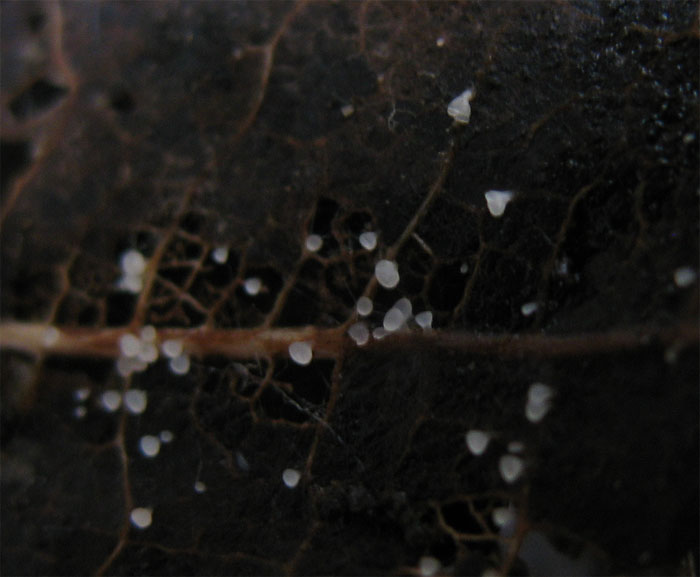
I found these on my own yard on (Betula) leaves today.
These are about 0,2-0,5 mm wide:
Marja Pennanen,
20-10-2010 13:36
Re:Hemiamyloid on leaves
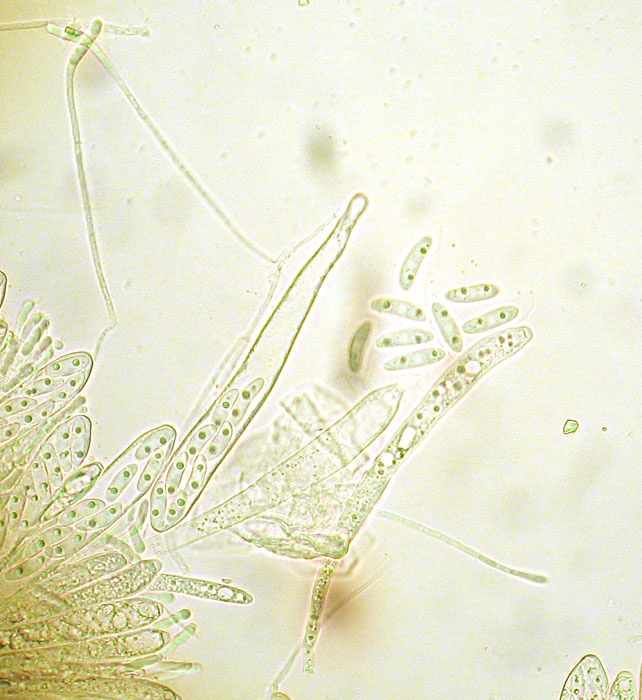
The spores are 15-18x4-5, with two small droplets.
Asci are 100-130x10-12 and hemiamyloid (IKI red).
Paraphysesa are 2-3 micrometers wide and can branch.
Asci are 100-130x10-12 and hemiamyloid (IKI red).
Paraphysesa are 2-3 micrometers wide and can branch.
Marja Pennanen,
20-10-2010 13:37
Re:Hemiamyloid on leaves
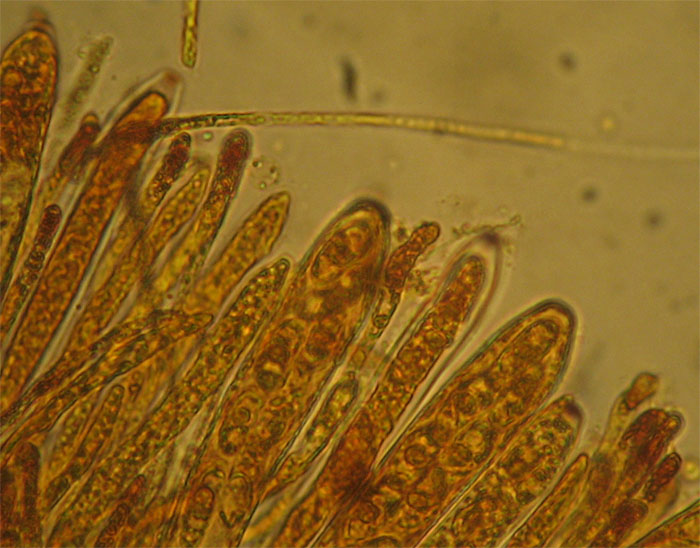
Ascus tips in Lugol.
I found no Calycellina, that fits.
Marja
I found no Calycellina, that fits.
Marja
Hans-Otto Baral,
20-10-2010 15:37

Re:Hemiamyloid on leaves
Hi Marja
splendid microphoto! This is an Allophylaria, closely related to Calycellina in my opinion. I think it is A. zenobiae (maybe as Conchatium in Index Fungorum). A. nervicola has shorter spores.
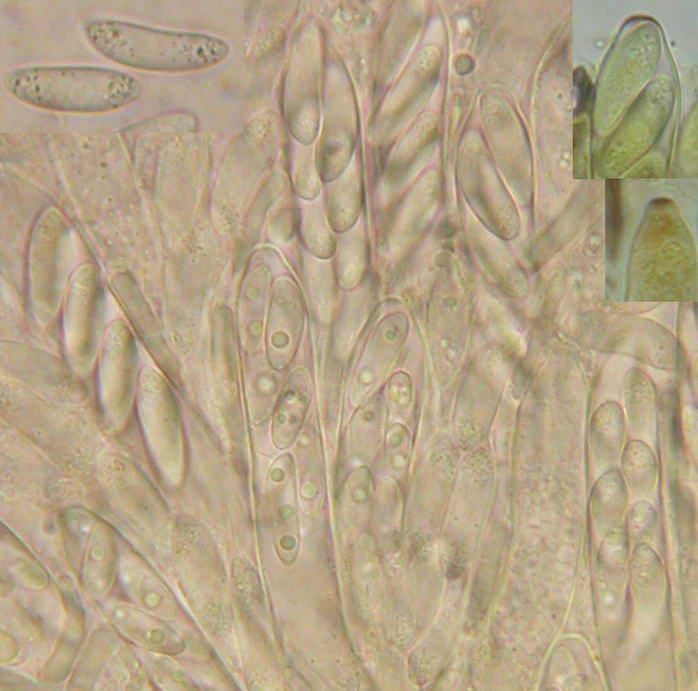
Oil drops in spores are usually some minute near each end, but submature spores have one bigger as you figure.
If you look at the excipulum near stip or near margin the cells should be a bit gelatinized (other Allophylarias have more gel).
Zotto
splendid microphoto! This is an Allophylaria, closely related to Calycellina in my opinion. I think it is A. zenobiae (maybe as Conchatium in Index Fungorum). A. nervicola has shorter spores.
Oil drops in spores are usually some minute near each end, but submature spores have one bigger as you figure.
If you look at the excipulum near stip or near margin the cells should be a bit gelatinized (other Allophylarias have more gel).
Zotto
Marja Pennanen,
20-10-2010 21:44
Re:Hemiamyloid on leaves
Thank you :)
All information is more than wellcome.
I only know Allophylaria vulgaris, which is very common here now for instance on Betula twigs.
I (almoust) know it from it's appearance and haven't studied it for a long time, maybe it's time for a comparision.
This species maybe once again new to Finland-or maybe not...
Marja
All information is more than wellcome.
I only know Allophylaria vulgaris, which is very common here now for instance on Betula twigs.
I (almoust) know it from it's appearance and haven't studied it for a long time, maybe it's time for a comparision.
This species maybe once again new to Finland-or maybe not...
Marja
Hans-Otto Baral,
20-10-2010 21:52
Re:Hemiamyloid on leaves
Probably new. But A. vulgaris is not an Allophylaria, it is a Calycina.
I admit the two genera are quite close....
Calycina vulgaris is inamyloid, can you confirm?
Zotto
I admit the two genera are quite close....
Calycina vulgaris is inamyloid, can you confirm?
Zotto
Marja Pennanen,
20-10-2010 22:12
Re:Hemiamyloid on leaves
Let's see, if I have a specimen. If I did not collect it, I'll do that later this week.
I've got Lugol only for maybe half a year and haven't used it for this (A. or) C. vulgaris yet.
Marja
I've got Lugol only for maybe half a year and haven't used it for this (A. or) C. vulgaris yet.
Marja
Marja Pennanen,
20-10-2010 23:08
Re:Hemiamyloid on leaves
Hello,
Zotto you making me doubt everything I thought I knew. Maybe I'll bring all the species here just to be sure ;)
I had some on the twig, where was R. firma, too.
I can't say, that the fungus I thoght originally as A. vulgaris is inamyloid, but I can't say that it's amyloid either. It's not so obvious, maybe it's hemiamyloid...
Just too tired now, I'll go and get some rest: Marja
Zotto you making me doubt everything I thought I knew. Maybe I'll bring all the species here just to be sure ;)
I had some on the twig, where was R. firma, too.
I can't say, that the fungus I thoght originally as A. vulgaris is inamyloid, but I can't say that it's amyloid either. It's not so obvious, maybe it's hemiamyloid...
Just too tired now, I'll go and get some rest: Marja