
28-04-2026 22:51
 Bernard CLESSE
Bonsoir à toutes et tous,Pourriez-vous m'aider à

28-04-2026 21:50
 Pablo Sandoval
Hola a todos,Espero se encuentren bien. Hace mucho
27-04-2026 18:05
 Lothar Krieglsteiner
... still attached at standing tree. The green con
28-04-2026 20:33
Vitus SchäfftleinHello, I found Trochila ilicina on Ilex aquifoliu
28-04-2026 20:07
Lothar Krieglsteiner
... on twig in the air at standing Ceratonia siliq
27-04-2026 20:52
Lothar Krieglsteiner
Found on hanging tiwg of Olea europaea in dried-ou
27-04-2026 18:48
Tony MoverleyCollected 23rd April 2026, Norfolk, EnglandSwarms
27-04-2026 17:41
Lothar Krieglsteiner
.. Algarve, same leaf than the last post. The con
27-04-2026 17:16
Lothar Krieglsteiner
.. Algarve, moist lying.The conidiomata look like
Pale on Betula leaves
Marja Pennanen,
14-09-2010 09:43
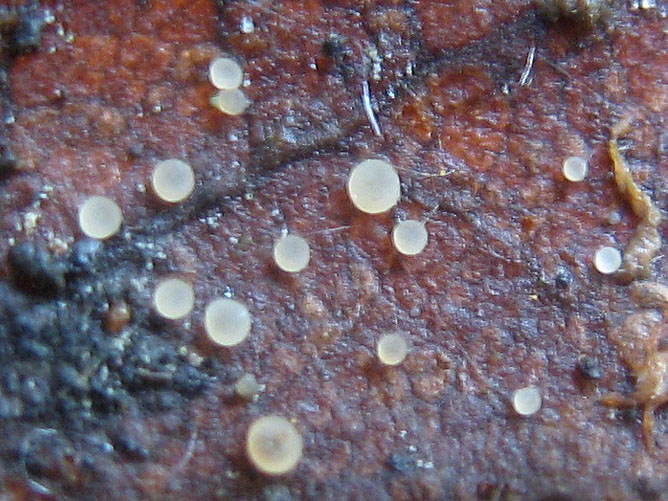
as I mentioned I found something besides the Calycellina on Betula leaves.
These are a bit bigger maybe 0,2-0,3 mm wide.
Marja Pennanen,
14-09-2010 09:50
Re:Pale on Betula leaves
Once again I tried to determine without a result :(
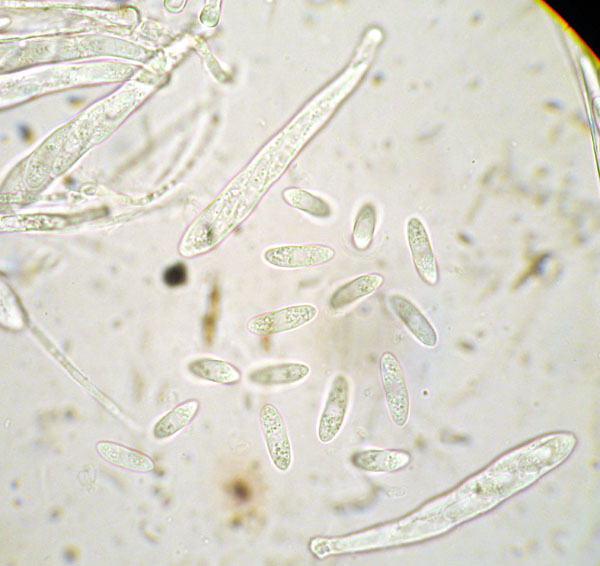
The spores are 12-15x3-4, multiguttulate. But seems not always to have droplets in the middle, where they are often a little narrower.
The asci are about 60-95x8-10, IKI+ and paraphyses 2-3 micrometers wide at tips, sometimes with vacuoles.
I'm very happy, because I can loan a microscope from the university until 22.10 :)
Marja
The spores are 12-15x3-4, multiguttulate. But seems not always to have droplets in the middle, where they are often a little narrower.
The asci are about 60-95x8-10, IKI+ and paraphyses 2-3 micrometers wide at tips, sometimes with vacuoles.
I'm very happy, because I can loan a microscope from the university until 22.10 :)
Marja
Uwe Lindemann,
14-09-2010 10:09

Re:Pale on Betula leaves
Hello Marja,
it's possibly Hymenoscyphus sparsus...
Best Uwe
it's possibly Hymenoscyphus sparsus...
Best Uwe
Marja Pennanen,
14-09-2010 10:33
Re:Pale on Betula leaves
Thank you,
nice to "meet".
I checked Zottos DVD and despite of almoust lacking stipe it seems a good option.
I really have no other material of that species myself.
So this determination (going trough the DVD and still propably not noticing) would have required very much time when not looking for Hymenoscyphus at first (Allophylaria or ...).
By the way, I though that these could be making septa in spores. Is this kind of droplet behavior a sign for this?
Fungal greetings: Marja
nice to "meet".
I checked Zottos DVD and despite of almoust lacking stipe it seems a good option.
I really have no other material of that species myself.
So this determination (going trough the DVD and still propably not noticing) would have required very much time when not looking for Hymenoscyphus at first (Allophylaria or ...).
By the way, I though that these could be making septa in spores. Is this kind of droplet behavior a sign for this?
Fungal greetings: Marja
Hans-Otto Baral,
14-09-2010 11:12

Re:Pale on Betula leaves
Hi Marja
I agree with Uwe, this is a good option. Anyhow I would like to see the contents of the living paraphyses. Also the shape of the apical ring is important to be sure with Hymenoscyphus. Calycellina also may have such spore constriction. I assume you saw a blue IKI-reaction.
Zotto
I agree with Uwe, this is a good option. Anyhow I would like to see the contents of the living paraphyses. Also the shape of the apical ring is important to be sure with Hymenoscyphus. Calycellina also may have such spore constriction. I assume you saw a blue IKI-reaction.
Zotto
Raúl Tena Lahoz,
14-09-2010 11:52

Re:Pale on Betula leaves
Hi to all
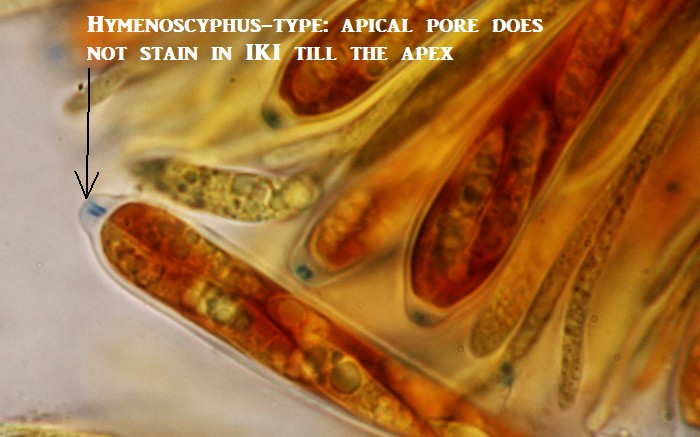
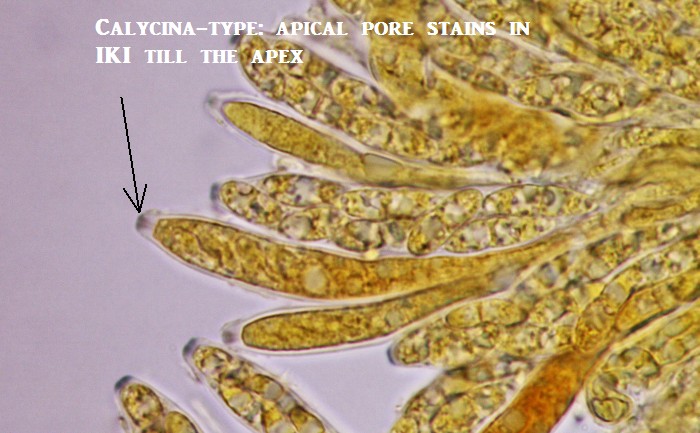
It would be good also to see a picture of asci tips in IKI in order to know if it is Hymenoscyphus-type or Calycina-type.
The "empty" space in the middle of the spore without oil droplets is where the nucleus is located. So then there is nothing else but the nucleus, which is less refractive. It is easy to stain it in IKI. If the spore develops a septum, then you should see two nucleus, one on each side of the septum. This empty space does not necessarily mean that it is going to develop a septum. Lots of species develop a septum when hypermature. It is important to say when the septum appears: inside asci or after, when hypermature,...
By the way, Marja species seems to have croziers. Can it be then Hymenoscyphus sparsus?
An option for Calycellina leucella?
Here a Hymenoscyphus-type asci.
Raúl
It would be good also to see a picture of asci tips in IKI in order to know if it is Hymenoscyphus-type or Calycina-type.
The "empty" space in the middle of the spore without oil droplets is where the nucleus is located. So then there is nothing else but the nucleus, which is less refractive. It is easy to stain it in IKI. If the spore develops a septum, then you should see two nucleus, one on each side of the septum. This empty space does not necessarily mean that it is going to develop a septum. Lots of species develop a septum when hypermature. It is important to say when the septum appears: inside asci or after, when hypermature,...
By the way, Marja species seems to have croziers. Can it be then Hymenoscyphus sparsus?
An option for Calycellina leucella?
Here a Hymenoscyphus-type asci.
Raúl
Raúl Tena Lahoz,
14-09-2010 11:53
Re:Pale on Betula leaves
Now a Calycina-type asci, in this case hemiamyloid, rb type.
Hans-Otto Baral,
14-09-2010 13:24
Re:Pale on Betula leaves
Wonderful, Raul, you presented the facts very clear. I also wished to mention the nuceli, and I can only add that you mean living asci in wich the spores either form a septum or not.
Calycellina leucella has usually narrower spores, but there exist other species and this genus at least is well an option.
Zotto
Calycellina leucella has usually narrower spores, but there exist other species and this genus at least is well an option.
Zotto
Marja Pennanen,
15-09-2010 14:45
Re:Pale on Betula leaves
Hello,
sorry this late answer, I've been picking Boletus, got 30 liters :)
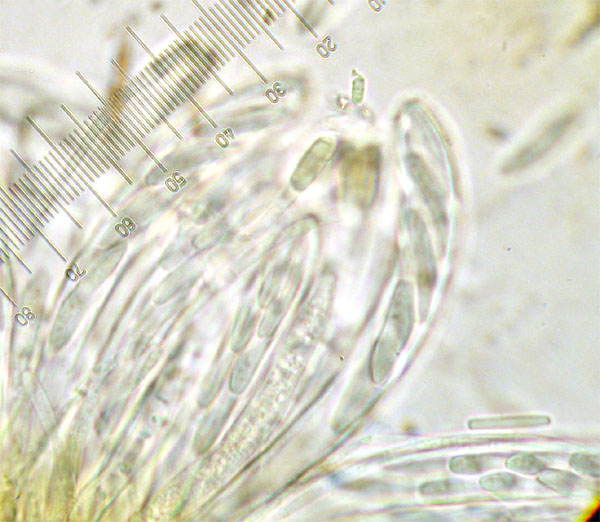
Heres a photo of paraphyses, the only one I found.
sorry this late answer, I've been picking Boletus, got 30 liters :)
Heres a photo of paraphyses, the only one I found.
Marja Pennanen,
15-09-2010 14:46
Re:Pale on Betula leaves
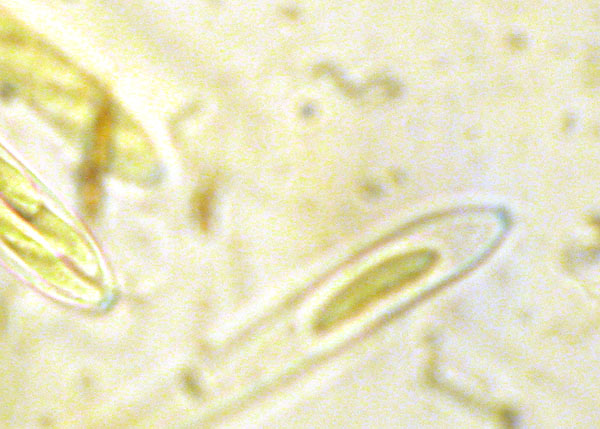
Asci in Lugol, no better photos, sorry again.
Thank you for the explanations :)
Marja
Thank you for the explanations :)
Marja
Hans-Otto Baral,
15-09-2010 16:26
Re:Pale on Betula leaves
In any case this is enough and the species is a Calycellina! Raul was right, and he is even right with leucella. The spores are a bit short for their breadth, but C. leucella is very variable, almost incredible for a single species.
Zotto
Zotto
Raúl Tena Lahoz,
15-09-2010 17:51
Re:Pale on Betula leaves
Never met Calycellina leucella but spores seems to vary a lot, also maybe due to ascus turgor? Does the spore breadth shrinkage inside the asci disappear immediately when the spores are fired out? Or it stays for a while?
Cheers,
Raúl
PD: I also went out today for Boletus, but brought home a lot of Helotiales ;)
Cheers,
Raúl
PD: I also went out today for Boletus, but brought home a lot of Helotiales ;)
Hans-Otto Baral,
15-09-2010 22:07
Re:Pale on Betula leaves
Yes, spores inside living asci are sometimes compressed to maybe 70% of their width when free. Ejected spores rapidly inflate (within some seconds). In Orbilia they do not shrink inside the living asci, but they collapse in the fully turgescent asci, because they have a rather rigid spore wall. For shrinkage the wall must be elastic, and this is often the case in the Helotiales .
Therefore I strongly prefer in the Helotiales ejected spores for measurements and drawings/photos, or those inside dead asci. nIn C. leucella the free spores highly vary in width among the finds.
Zotto
Therefore I strongly prefer in the Helotiales ejected spores for measurements and drawings/photos, or those inside dead asci. nIn C. leucella the free spores highly vary in width among the finds.
Zotto
Raúl Tena Lahoz,
15-09-2010 22:53
Re:Pale on Betula leaves
Ok, all clear.
Thanks Zotto,
Raúl.
Thanks Zotto,
Raúl.