
28-04-2026 20:07
 Lothar Krieglsteiner
... on twig in the air at standing Ceratonia siliq
14-04-2026 05:32
Ethan CrensonHi all, A few weeks back a friend pointed out som
28-04-2026 20:33
Vitus SchäfftleinHello, I found Trochila ilicina on Ilex aquifoliu

30-04-2026 10:28
Rot BojanHello, by appearance I would say that I am dealing
27-04-2026 18:48
Tony MoverleyCollected 23rd April 2026, Norfolk, EnglandSwarms
27-04-2026 20:52
Lothar Krieglsteiner
Found on hanging tiwg of Olea europaea in dried-ou
28-04-2026 22:51
 Bernard CLESSE
Bonsoir à toutes et tous,Pourriez-vous m'aider à
29-04-2026 08:01
Lothar Krieglsteiner
... on twig attached to small tree of Citrus auran
29-04-2026 10:44
Lothar Krieglsteiner
growing at moist, drying-out soil at the side of a
Lophiostomataceae
Gernot Friebes,
16-03-2010 21:10
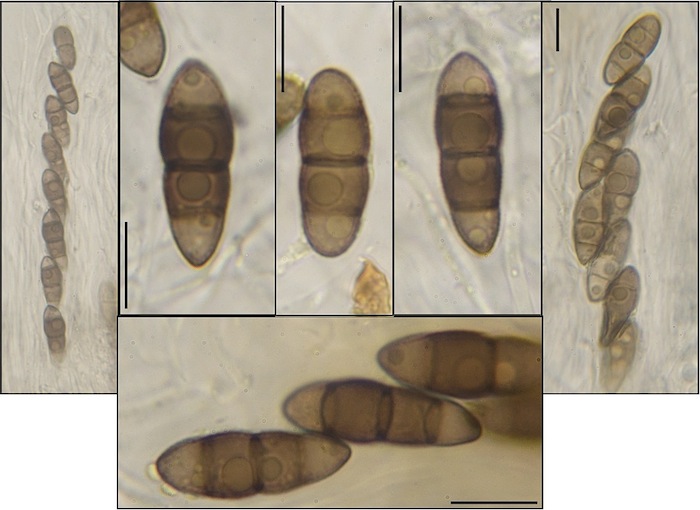
here I have a second indeterminate pyreno which grew on the bark of a living Fraxinus. The ascomata are very conspicuous because they can be from Navicella-like with a small, slit-shaped neck to even Ceratostomella-like with a long and thin neck (I checked that they really are of the same species). The spores are 22,5-25 x 8-9 µm, mature always 4-celled and slightly rough, often with two paler end-cells. The asci are bitunicate and 8-spored. I didn't find a species within the Lophiostomataceae which would fit with my species.
Best wishes and many thanks,
Gernot

Gernot Friebes,
16-03-2010 21:11
Re:Lophiostomataceae
micros (scale=10 µm):
Christian Lechat,
16-03-2010 21:16

Re:Lophiostomataceae
Hi, Gernot,
I think your fungus is maybe Lophiostoma maculans H. Fabre
All the best,
Christian
I think your fungus is maybe Lophiostoma maculans H. Fabre
All the best,
Christian
Gernot Friebes,
16-03-2010 22:18
Re:Lophiostomataceae
Hi Christian,
thank you very much! The photos of your find and the description by Saccardo fit quite well. It seems to be a rare species, at least there is apparently not much literature on it. Even google provides only few hits.
Best wishes,
Gernot
thank you very much! The photos of your find and the description by Saccardo fit quite well. It seems to be a rare species, at least there is apparently not much literature on it. Even google provides only few hits.
Best wishes,
Gernot