20-02-2018 14:48
Me llega material seco desde Galicia, enmadera s
20-02-2018 17:12
Bernard CLESSE
Bonjour à toutes et tous,Aucune certitude qu'il s
19-02-2018 11:57
Bernard CLESSE
Voici un pyréno trouvé sur tronc mort de cornoui
05-08-2014 10:24
Miguel Ángel Ribes
Goog morning friends This small black soft 800-1.
14-02-2018 20:35
Bernard CLESSE
Bonsoir à toutes et tous,J'ai trouvé récemment
16-02-2018 13:15
En hoja de aceboA ver si hay alguna sugerenciaSalu
14-02-2018 21:54
Bernard CLESSE
Sur tronc mort de lierre.Je pense qu'il s'agit de
17-02-2018 17:06
Pavol PaloHello friends,I would be very grateful for this ar
En principio pense an alguna Tremellaceae, pero no veo nada parecido
Los apotecios, son como bolas de 1-2 mm. y tienen una consistencia dura hasta ronper, como pasa con la cascara de un huevo
A ver si hay alguna sugeencia
Saludos
Joseba
About the mushroom. yes, it's undoubtly a member of Tremellaceae. a Tremella sp. . According to recent advances in the knowledge of this Genus, all live as parasites on other fungi, especially Stereum, but on Pyrenomycetes too, like yours. (Diaporthe? Hypoxylon?) and are host-specific (species or genus).
Probably another member could add further informations, perhaps a species name.
Bien cordialement
Jacques
No te martirices por no haber aprendido Español, yo he estudiado durante años el Ingles y tampoco he conseguido aprenderlo´
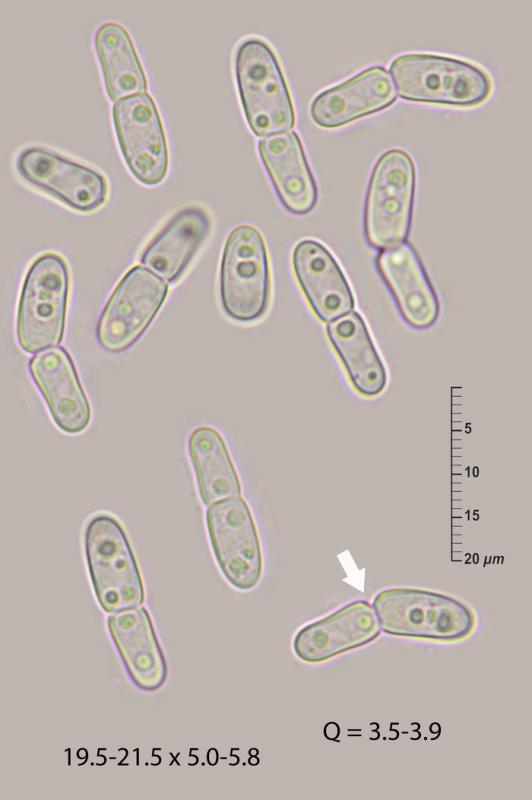
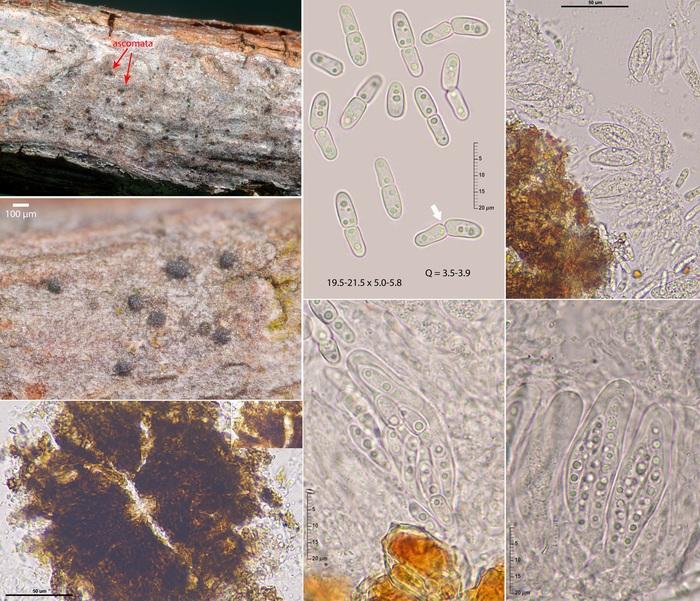
He estado estudiando el hongo sobre el que esta parasitando y aunque solo he podido encontrar esporas en las 4 muerstras que he preparado, creo que lo que es claro es que se trata de un Diatrype, aunque no he podido localizar cual, porque las medidasa de las esporas que he tomado son demasiado grandes para los que yo conozco.
Pongo las fotos a ver si puedes ayudar a alguien a darme alguna pista
Saludos
Joseba
Buena tarde Joseba
For me, both pictures of the pyrenomycete are consistent with Diatrype stigma, rather than D. disciformis (forming "true" discs, and spores much smaller) althought the carpophores (ascomes) aren't confluent as yet. But for the Tremella, I'm unable to put a sp. name on it; perhaps somebody in the forum could help?
About Spanish, I refuse to use Google translator or anything like, just a dictionnary to translate words I do not understand. Spanish and Italian (and Portuguese) are alongside French latin-based languages, so I try to find out the root of each word (e. g. "martirice", I think has the same root than the french "martyr" with is stronger) and hence the meaning.
Bonne soirée
Cordialement
jacques
Saludos
Joseba
Hola Joseba,
I found the original description of Sirobasidium, from Brazil; I don't know if the fungus has since been described from elsewhere in the world: it has been recorded in UK, so... Your specimens grow obviously ON the Pyrenomycetes. The swollen hyphae ("bubbles") are consistent with Tremella, but not the spores (globose by Tremella)???
https://www.biodiversitylibrary.org/page/13076899#page/367/mode/1up
Sorry, no further idea...
Bonne soirée
Jacques