Accès membres

Mot de passe perdu? S'inscrire

29-05-2018 17:39

Ethan Crenson

Hello all, I found this in the Northeastern US (S

31-05-2018 20:26

Castillo Joseba Castillo Joseba

A ver que os parece esta, en bosque de AbetosSalud

27-05-2018 18:12

Edouard Evangelisti Edouard Evangelisti

Cher tous, De passage en terre brigasque en Itali

31-05-2018 20:29

Castillo Joseba Castillo Joseba

he encontrado estos ejemplares  de forma redonda

29-05-2018 19:42

Viktorie Halasu Viktorie Halasu

Hello forum,J.A.Nannfeldt in his 1966 paper ("On O

03-06-2016 22:10

Dartanha Soares Dartanha Soares

Hi to all,I found this fungus on a decorticed wood

27-05-2018 20:21

Andgelo Mombert Andgelo Mombert

Bonsoir,Sur bois mort de feuillu immergé dans un

29-05-2018 19:50

Nicolas VAN VOOREN Nicolas VAN VOOREN

Bonsoir.Je suis à la recherche de cet article :Ra

29-05-2018 14:33

François Bartholomeeusen

Dear forum members,In a newly mown, very humid, fl

20-05-2018 12:13

Rubén Martínez-Gil Rubén Martínez-Gil

Hola a todos. Subo unas fotos de una Ciboria que

« < 651 652 653 654 655 > »
Encoelia fascicularis (?)
Ethan Crenson, 29-05-2018 17:39
Hello all,

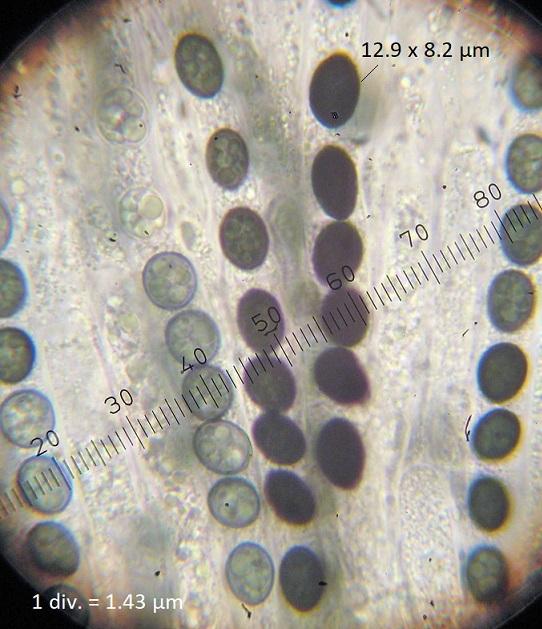
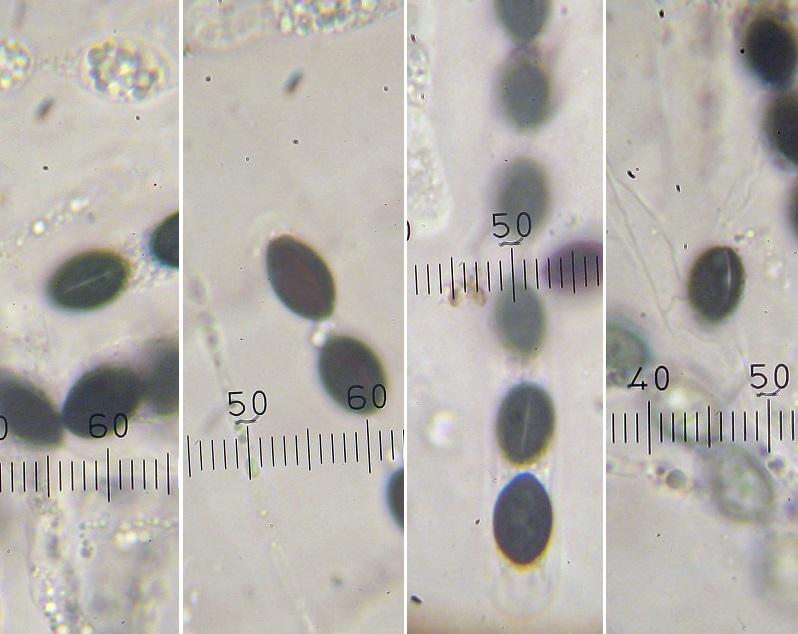
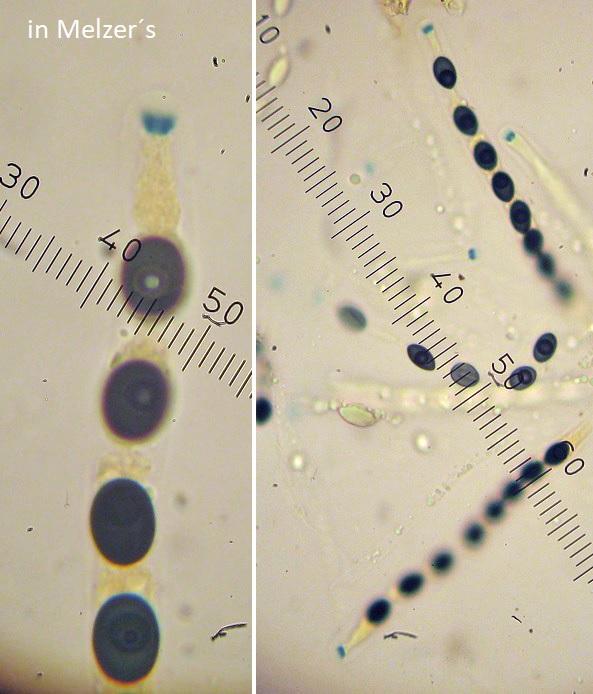
I found this in the Northeastern US (Southern Vermont) yesterday.  It is on Populus.  Peniophora rufa is present on the same branch.  I believe P. rufa grows exclusively on P. grandidentata and P. tremuloides . The fruiting bodies are .5 - 1.5cm, brown and emerging in clusters from gaps in the bark.  The outer surface of the smaller ones have fine white hairs.  Asci IKI negative, 104-124 by 10-11µm.  Spores 12-16 by 3.5-4µm, curved.  Ectal excipulum textura globulosa.  Medullary excipulum textura intricata.  Paraphyses enlarged at the tips, perhaps slightly brown (?) approximately 4µm wide.

I'd be happy to provide any additional information if anything is missing here.

Thanks in advance,

Ethan
  • message #53597
  • message #53597
  • message #53597
  • message #53597
  • message #53597
  • message #53597
  • message #53597
  • message #53597
  • message #53597
  • message #53597
  • message #53597
Hans-Otto Baral, 29-05-2018 18:13
Hans-Otto Baral
Re : Encoelia fascicularis (?)
Yes, it looks so. The genus has changed, it is now Sclerencoelia fascicularis, because Encoelia furfuracea is very distantly related, and this one belongs in Sclerotiniaceae.

There is, however, a North American species on Populus, S. pruinosa. We know it, e.g., from a recent collection by Joey Tanney from Quebec, on Populus grandidentata or P. tremuloides.

It has abundant crystals, probably therefore the name, but crystals occur also in S. fascicularis. I am not sure about a certain record of that species in America.

Zotto
Ethan Crenson, 29-05-2018 18:33
Re : Encoelia fascicularis (?)
Thank you, Zotto.  The "abundant crystals" of S. pruinosa are the fine hairs on the outside of the fruiting body, or something else?
Hans-Otto Baral, 29-05-2018 21:11
Hans-Otto Baral
Re : Encoelia fascicularis (?)
Nono, I mean octaedric crystals. maybe I see very small ones on your excipulum, but when you look at Tanney's photos they are striking (folder Sclerencoelia in Sclerotiniaceae on my homepage).
Joey JTan, 01-06-2018 03:40
Re : Encoelia fascicularis (?)
Last weekend I collected what is likely S. fascicularis on a dead Populus tremuloides branch still attached to a living tree. The branch was covered in S. fascicularis apothecia as well as Valsa sordida pycnidia; it was quite impressive, at least until my dog destroyed the specimen that I brought back with me (at least she waited until I had taken photos).

Yesterday I took my dog for a walk and found a nice specimen of S. pruinosa on the bark of a dead Populus tremuloides tree. Macroscopically, the apothecia are quite smaller than S. fascicularis, more densely coated in crystals (it looks like they are sprinkled with salt), and when dry they are inrolled and appear triangular or clam-like. From my few observations of these species, it seems that S. fascicularis is on dead branches and S. pruinosa on the bark of dead trees... maybe S. fascicularis is a branch endophyte that sporulates after branch death while S. pruinosa causes sooty bark canker? Sclerencoelia fascicularis apothecia are also erumpent from the branch and appear in clusters (fascicular) whereas S. pruinosa apothecia are gregarious but not in such distinct clusters.

I will moisten my S. pruinosa specimen, which is out of the dog's reach, and try to take better photos tomorrow.
  • message #53614
  • message #53614
  • message #53614
  • message #53614
  • message #53614
Hans-Otto Baral, 01-06-2018 07:08
Hans-Otto Baral
Re : Encoelia fascicularis (?)
Hi Joey!
I fully agree with your hypothesis, I think it is also what is known about S. pruinosa being the caus of a canker. And with "bark" you mean trunk bark, because all Sclerencoelia species grow on bark. 

Your last pic refers to S. pruinosa?
Zotto
Joey JTan, 01-06-2018 20:13
Re : Encoelia fascicularis (?)
Yes the bark on the trunk of the tree, not the branches. The last picture is of S. pruinosa - I just took some rather poor low-res pictures now, but you can see the crystals and some hydrated apothecia.

I will have to keep an eye out for sooty bark canker symptoms on living trees, because I have only noticed the apothecia on dead trees with the bark already sloughing off. In my area (eastern Canada), Entoleuca mammata is the major canker-causing fungus on poplar, whereas sooty bark canker is apparently the most important poplar canker in western Canada.
  • message #53633
  • message #53633
  • message #53633
  • message #53633
  • message #53633
  • message #53633
Hans-Otto Baral, 01-06-2018 21:21
Hans-Otto Baral
Re : Encoelia fascicularis (?)
O.k., this is impressive!