
22-02-2021 11:46
 Castillo Joseba
Me mandan el material seco de Galicia, recolecta
21-02-2021 15:21
Sergey MarkovI found a lot of small pyrenomycetes on piece of u
21-02-2021 15:14
 Joop van der Lee
Found on cow dung.This species drew my attention b
20-02-2021 10:17
Joop van der Lee
Found on hare dungPerithecia 246x191 umAsci: 8-spo
17-02-2021 18:38
 Sven Heinz
Hallo, can this aquatic hyphomycete be Dendrospor
17-02-2021 23:29
Unai FernandesHello!I have collected these specimens on woody dr
asco sp.
Yannick Mourgues,
30-01-2009 22:50
 Hi.
Hi.Need help for this specie. I'm sure I have seen it in this forum next year, but not able to find it again.
Host: on decayed wood of Fraxinus.
Macro: many apo. short stipited, hymenium yellow to grey-green, Excipulum grey-green with many short yellow hairs. Base grey-green to black.
Micro :
spores 7-8,4x3,8-4,1 um, without guttules. Q=1,8-2,1.
Ascus 60-80x5-6 um, with croziers, IKI+
Paraphyses spindly, rounded at the end, with some guttules, 1-2 um widh, 70 to 100 um long.
Hairs brown, septate, more then 4 celled, 100-120x5-6 um. Becomes green With Lugol.
Have you got an idea ?
Yannick
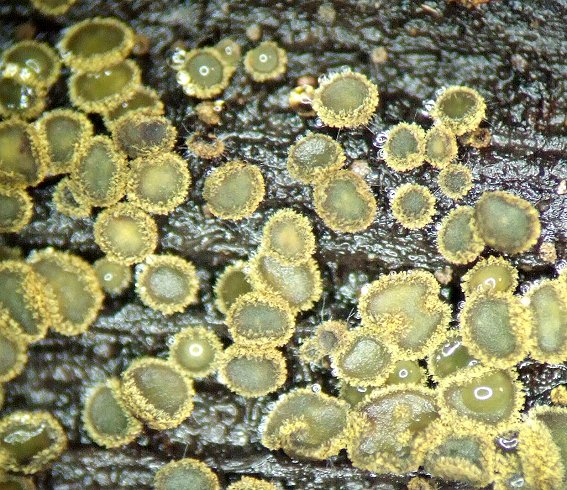
Yannick Mourgues,
30-01-2009 22:50
Re:asco sp.
another pict...
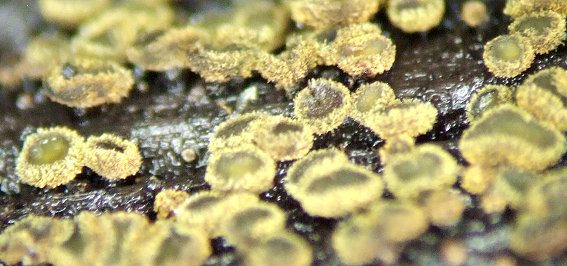
Yannick Mourgues,
30-01-2009 22:50
Re:asco sp.
Micro...
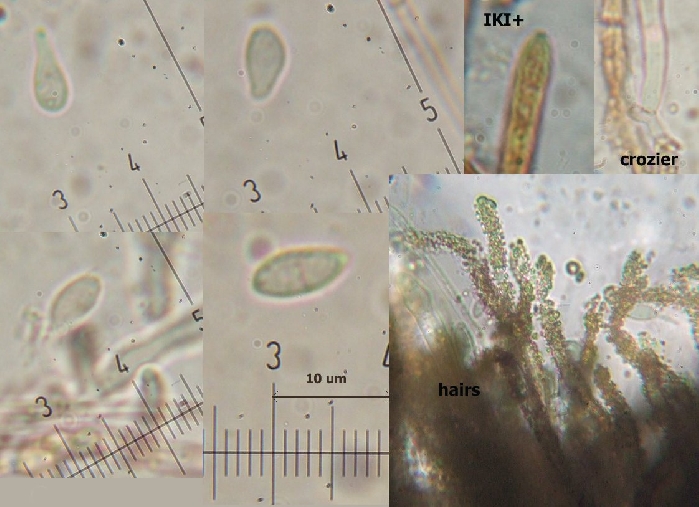
Guy Garcia,
30-01-2009 23:22
Re:asco sp.
Neodasysycpha cerina ?
Yannick Mourgues,
30-01-2009 23:37
Re:asco sp.
Oui, voilà ! C'est ça.
Je m'étais arrêté à Lachnum cerinus/a sans trouver ce genre.
Merci Guy !
Yannick
Je m'étais arrêté à Lachnum cerinus/a sans trouver ce genre.
Merci Guy !
Yannick
Hans-Otto Baral,
30-01-2009 23:38

Re:asco sp.
Yes, je pense la même. But N. cerina MUST be simple septate, and I feel your image does not show a crozier. You can test with KOH: usually this species yields a purplish dye from the hairs into the medium.
Zotto
Zotto
Yannick Mourgues,
30-01-2009 23:42
Re:asco sp.
I'm going to try KOH.
What does it mean : "simple septate" ?
What does it mean : "simple septate" ?
Yannick Mourgues,
30-01-2009 23:52
Re:asco sp.
Hairs in KOH seems to become black.
Yannick
Yannick

Stip Helleman,
31-01-2009 01:04

Re:asco sp.
Hi Yannick,
simple septate means without croziers, and the purplish dye comes from the excipulum.
Stip
simple septate means without croziers, and the purplish dye comes from the excipulum.
Stip
Yannick Mourgues,
31-01-2009 01:11
Re:asco sp.
Thank's Stip !
Y
Y
Hans-Otto Baral,
31-01-2009 11:10
Re:asco sp.
I noted the purplish dye from the hairs (similar as in Perrotia flammea), but maybe it comes also from the excipulum. This dye is strongest at the moment when the KOH comes in contact with the fungus, later it rapidly dilutes. If you simply mount a fragment in KOH you will not see it. Therefore either put an apo under the bino in a drop of KOH during which you look what happens, or you add KOH to a water mount and look what happens as soon as the KOH reaches the fungus.
Zotto
Zotto