
14-04-2026 05:32
Ethan CrensonHi all, A few weeks back a friend pointed out som
14-04-2026 21:52
Gernot FriebesHi,found on dead leaves of Carex elata. Conidia: 4
14-04-2026 20:31
Gernot FriebesHi,can this be Psilachnum lateritioalbum on Phragm
12-04-2026 17:56
 Hardware Tony
Found on dead stems in February earlier this year
12-04-2026 15:52
Gernot FriebesHi,I'm looking for help with this anamorph collect
12-04-2026 12:22
 William Slosse
In a dune grassland in Oostduinkerke (Belgium), on
11-04-2026 15:45
 Zuzana Sochorová (Egertová)
Please, could anyone send me this paper?Moyne G.,
11-04-2026 13:34
Artem PtukhaHello, I am seeking assistance with the identific

11-04-2026 10:19
 Michel Hairaud
Chers amis d'Ascofrance , voici une très bonne no
this species puzzles me a bit. It grows under the bark of twigs (Castanea sativa according to the person who collected it) and doesn't develop much of a stromatic tissue between the perithecia but it does form small and rather well-defined pustules. Asci are long cylindrical, very thin-walled and fragile and I'm not sure about the number of ascospores but I have actually never counted more than 4 per ascus. They are also IKI-. Ascospores measure 15-21 x 10-13 µm and they are smooth, without sheaths or appendages but with a mostly straight germ slit over the whole length. Paraphyses are numerous, hyaline, filiform. Maybe you have an idea!
Best wishes,
Gernot
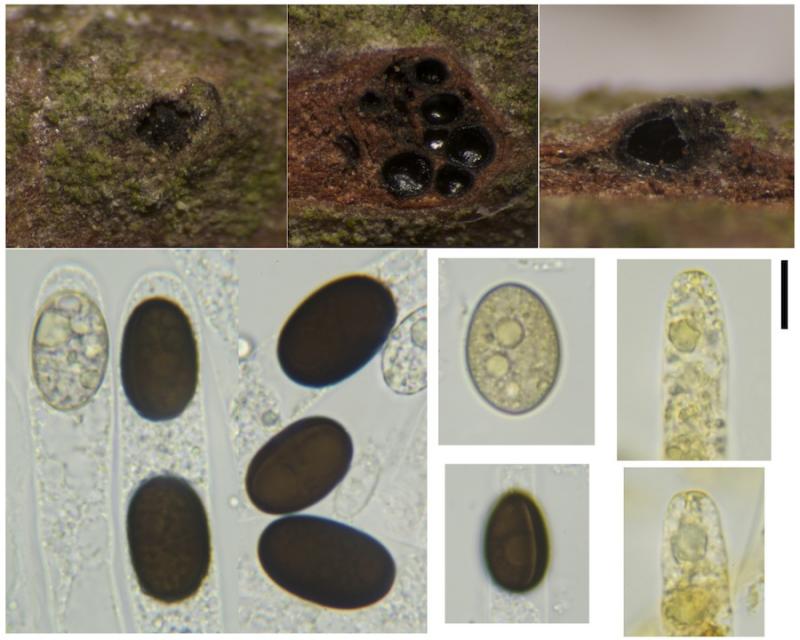

the microscopic characters of your fungus would fit Coniochaeta fairly well but the ascomata sunken in bark do not recall this genus. Did you try to search for small black setae around the ostiole?
Hope someone will come up with better suggestions.
Cheers,
Jacques
interesting, Coniochaeta didn't even cross my mind due to the macroscopic appearance. I haven't seen any setae but I'll have to check that again more carefully. Thanks!
Best wishes,
Gernot